Collaboration & safety awareness is fundamental for shunting yards operations in Rotterdam harbour.
In Rotterdam, Europe’s largest port, the fire-safety level is high, and with good reason. The shunting yards, where large volumes of hazardous substances are shunted in (tanker) wagons every day, are in a dynamic industrial environment with a lot of vital infrastructure and, in some cases, residential areas in the immediate vicinity. Continuity of operations is extremely important; Delay or drop-out of trains in Rotterdam immediately affects operations (tracks and yards) in Germany, Italy or Poland. Railway manager ProRail recently invested heavily in upgrading the firefighting and incident response systems at the yards, bringing them up to par with the requirements of the authority that issues and supervises the licences.
ProRail and incident preparation
ProRail is a private company under Dutch law, commissioned by the national government to manage, maintain and expand the Dutch railway network, grant non-discriminatory access and provide traffic control. Part of the railway network is the more than 40km-long port railway line that connects the Rotterdam harbour to the Dutch infrastructure and, at the borders, with German and Belgian tracks. The port railway line currently has five rail yards for freight trains. A sixth yard is under design. As the Rotterdam port area is one of the largest (petro)chemical clusters in Europe, with refineries, chemical production and tank terminals, large volumes of hazardous substances travel from the railway yards in rail tank wagons on their way to customers in the European rail freight corridors. In this extensive transport flow, the port yards connect to Kijfhoek, a humping-yard located outside Rotterdam. Kijfhoek is the largest shunting yard in the Netherlands and the only gravity-based humping yard.
Yards in a process-industry environment meet safety levels that fits the industry
Rick Warnar, director Yard improvement
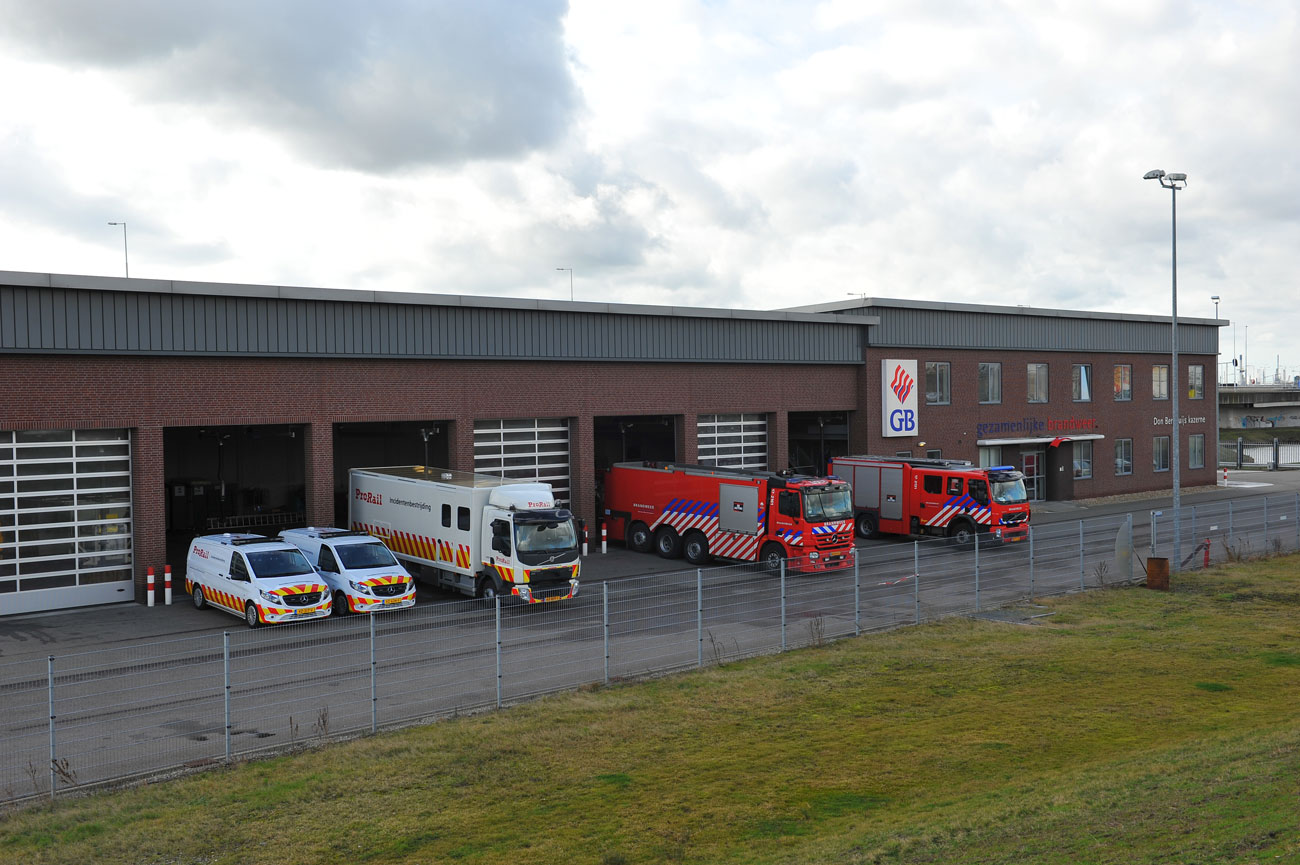
Although railway infrastructure and train equipment are very safe by design, reducing risk to ‘zero’ is too high an ambition. Incident frequencies are very low and local authorities set high standards. Fast and dedicated fire-safety provisions and emergency response capabilities form a strong ‘line of defence’ in a robust safety-management system on the yards. The public-private Joint Fire Brigade (GB) operating in the port area acts for the yards of ProRail as the collective company fire brigade for its yards. From its six fire stations, a first industrial firefighting truck with firefighting foam can be deployed on site at each yard within six minutes after alarm.
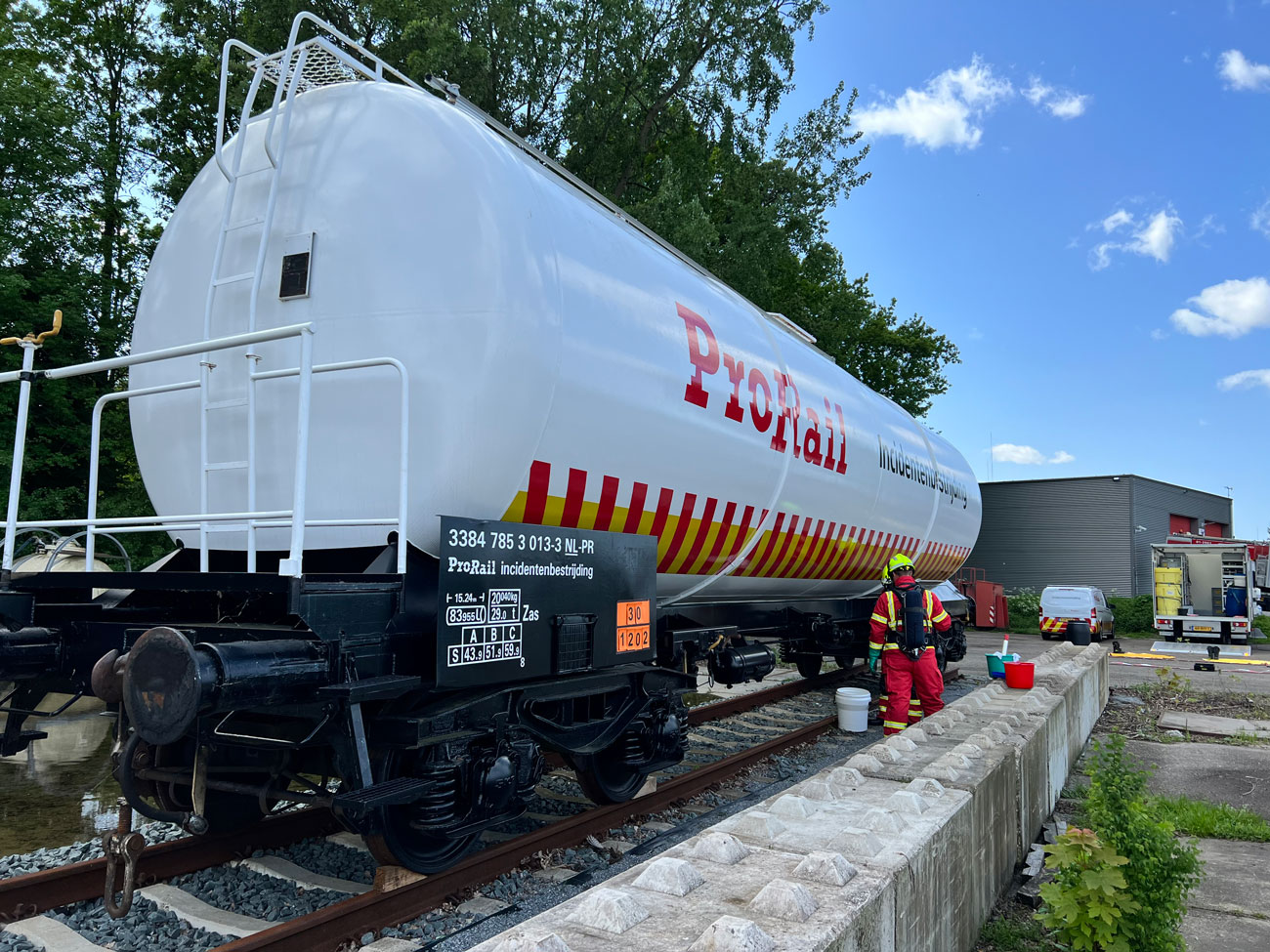
In addition, ProRail has its own specialised incident-response organisation, which includes recovery equipment and a hazmat team. The primary mission of ProRail Incident Response is to ensure unhindered rail transport, by quickly resolving (mostly minor) incidents such as drip leaks on railway tank wagons. The cooperation between the Joint Fire Brigade and ProRail Incident Control unites the interests of environmental safety and continuity of rail transport over the ‘lifeline’ of the port of Rotterdam. Equipment of GB and ProRail Incident Response are partly situated in the same fire station.


Emergency response & firefighting: the challenges
Shunting yards are large open areas with a series of rail tracks (some 40 to 60 tracks wide) on which trains arrive, disconnect, change locomotive and form new trains to travel to addresses abroad. The process of shunting can be done by dedicated shunting locomotives or by pushing trains uphill and letting gravity do the work (so called hump-yards). Preparation for combatting fires and chemical spills on yards give firefighters some specific dilemmas:
- Long tracks and long trains that cannot be separated – spanning extended distances which are not always available
- Difficult reachability of wagons of trains stationed in the tracks locked in by surrounding trains
- Logistical complexity of the area for regular firefighting equipment and vehicles
- (Non) Availability of large amounts of water (and possible foam) on all possible locations
- Obtaining an adequate geo-position and information about chemical content of the wagons
- Presence of high-voltage overhead lines above portions of the yard
- Specific procedures, protocols and action plans to follow in case of specific scenario types.
Although a yard, seen from a distance, looks like a large but simple and orderly logistics parking lot for trains, it is actually a complex infrastructure with strict co-dependant procedures that need close supervision, checks and balances. Large fires and spills are scarce because of solid packaging and slow speed limits in the yard.
Firefighting facilities for harbour yards
For several years, ProRail, as manager of shunting yards, has had to deal with a combination of factors: improvement of safety provisions following evaluation of incidents, ageing of existing provisions, stricter requirements and more intensive supervision by the competent authority. For the Rotterdam shunting yards, this so-called authority is the Rotterdam-Rijnmond Safety Region and the DCMR Environmental Agency. The Rotterdam port and industrial area comprises one of the largest clusters of Seveso-determined companies in Europe. Railway yards do not formally fall under the Seveso regulations, but the safety region and the environmental agency have set similarly high requirements for fire-safety facilities and incident-response procedures, at the level of Seveso establishments. This is understandable, as the railway yards are situated between large industries and tank terminals, vital traffic arteries and densely populated and vulnerable residential areas.
ProRail is fully compliant to the high safety demands set by the Rotterdam authorities
Taco Delhaas, project manager Yard improvement
The incident response procedure, grafted onto the normative scenarios ‘pool fire’, ‘BLEVE’ and ‘toxic outflow’, is guaranteed in terms of preparedness and responsiveness, thanks to the Joint Fire Brigade. However, the fire-water networks guaranteeing sufficient extinguishing water for these incidents needed an upgrade at the shunting yards. Additionally, the accessibility of all tracks for fire engines was not guaranteed, because of the size and layout of the yards. To solve these bottlenecks, ProRail launched the ‘firefighting facilities for harbour yards’ project in 2021. A sum of €230 million has been invested in high-quality firefighting water networks with automatic pumping facilities and new emergency roads to improve accessibility to incidents in the yards.
Execution: it’s all about collaboration
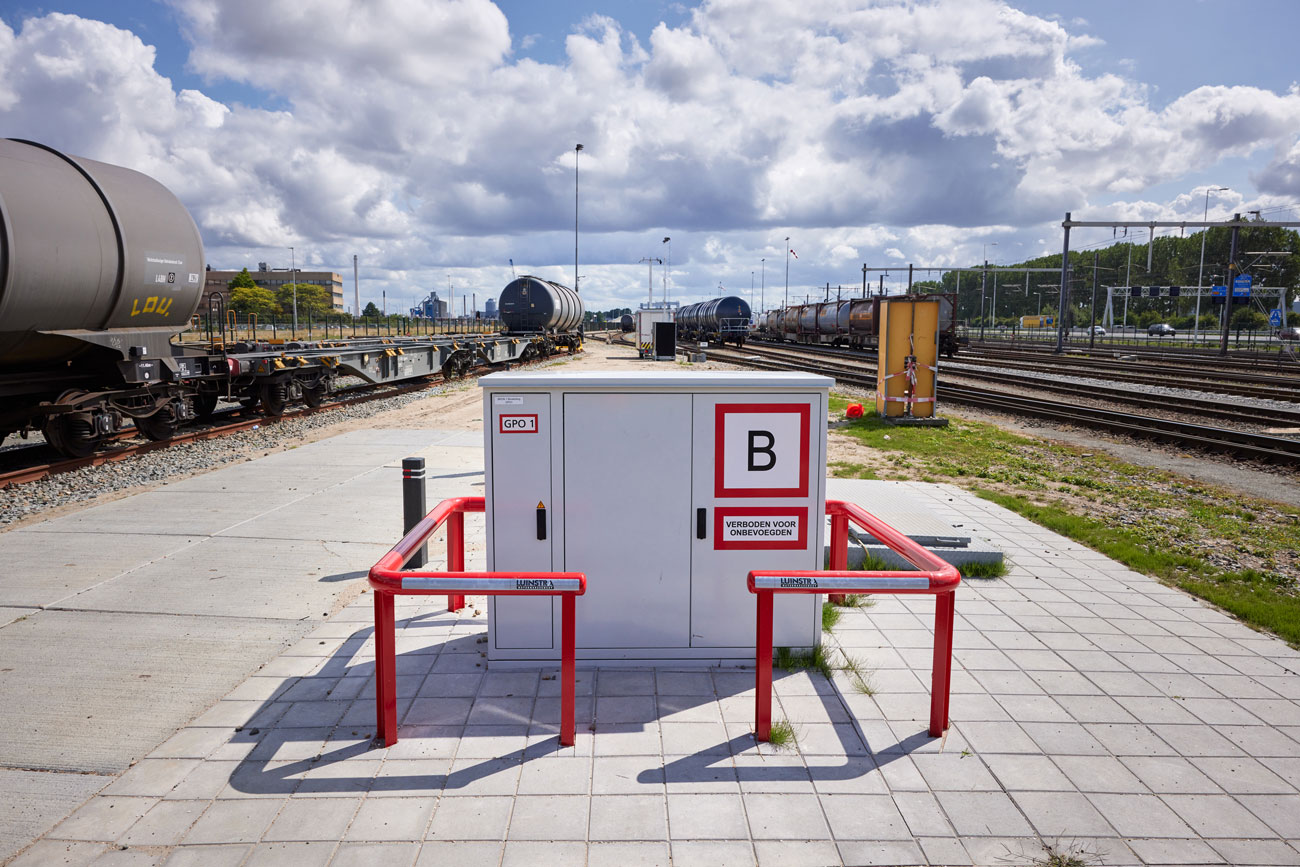
A total of 22km of pipes, spread across the five yards, have been laid for underground firefighting water networks, with 14 deep-well pumps feeding the networks with groundwater. At the Waalhaven-Zuid, Botlek and Maasvlakte yards (the yards with the highest risk profile) that guarantees water output to be 360m3 per hour. Those ring line grids have a hydrant placed every 50m, to which the fire brigade can connect its extinguishing units from the emergency road. In the Europoort and Pernis yards, the guaranteed minimum yield is 180m3 per hour, with hydrants every 100m.
The realisation of the fire lines and emergency roads was quite a challenge for ProRail, both technically and from an organisation perspective. There was considerable time pressure on the project. Due to stricter government supervision from 2020 and the identified bottlenecks in accessibility and firefighting water supply, restrictions on the shunting of wagons carrying hazardous substances were in force in parts of the railway yards. All efforts by the rail operator were aimed at lifting these restrictions as soon as possible by bringing firefighting facilities up to the required level. To do so, ProRail reserved a period of two years. A consortium of three contractors started work in early 2021. Implementation of the work was complex, in an environment where rail transport and shunting activities continue day and night, and with shunting yards adjacent to sites of industrial neighbours and public infrastructure.
Collaboration with public and private partners was therefore the key to the project’s success. Many interests had to be aligned and concrete agreements made to fit the new emergency roads and firefighting water networks into the infrastructure of the railway yards and their surroundings.
There is no common risk profile for yards; that’s why ProRail is in favour of local PPP-collaboration models
Rick Warnar, director Yard improvement
In a few locations, including Kijfhoek humping yard near Zwijndrecht (just outside Rotterdam harbour area), some tracks had to be renovated and updated to reduce the distances for a firefighting deployment with foam/water. This yard has a width of 260m, giving insufficient reach to the monitors from the emergency roads along the edges. After this infrastructural adjustment, effective firefighting deployment across the entire width of this yard is guaranteed.
In the shunting yards in the port, there was no such possibility for track rehabilitation. Here, the accessibility issue was resolved by building new emergency roads along the edges of the yards. At the Waalhaven-Zuid yard, ProRail partnered with neighbouring companies in the process. At the Pernis yard, near the Shell refinery, ProRail sought cooperation with Shell. For practical reasons, it was decided to connect the firefighting water network to Shell’s existing firefighting water network and pumping facilities. There were other challenges at the Botlek and Europoort yards. Here, on the premises of the yards, which are right next to the important A15 motorway through the port area, there was no room for emergency roads. After intensive consultations with road manager Rijkswaterstaat, it was decided to use the hard shoulder of the motorway as an emergency road.
On the other side of those yards, public roads are also used as emergency roads and sidings. Here, the existing cycle tracks have been widened for the purpose of providing the necessary space for firefighting vehicles. Finally, the Port of Rotterdam and the water board, the competent authority for water management and flood defences in the Rotterdam region, were important consulting partners.
The aforementioned examples make it clear that constructing new firefighting water networks and emergency roads in such a dynamic and intensively used environment with many stakeholders does not happen overnight. It was only through close cooperation that the interests of all parties could be met and the fire-safety provisions in the shunting yards upgraded to par.

Unique transitional solution: the fire train
Thanks to the extensive investment in accessibility and fire-extinguishing water supply, fire safety and operational incident response now meet the requirements in the new company fire permit. During realisation in the 2020–23 period, one of the largest port yards, Waalhaven-Zuid still allowed the shunting of wagons carrying hazardous substances. ProRail provided an equivalent firefighting solution at that yard with a unique temporary solution that met the requirements of the competent authority. As no fire-extinguishing water network and emergency road could be constructed in accordance with the requirements in the short term, the railway manager, in collaboration with a consortium of companies, provided a rail-based mobile firefighting facility in the form of a ‘fire train’.
Working the fifi-train should be as safe as working with a regular fifi-truck; remote operations brought just that
Jack Konings, fire-safety specialist, ProRail
It is without a doubt the biggest fire engine in the world, with a length of 67m, weight of 330 tons, water storage of 150,000 litres and 8,000 litres foam concentrate. Via fire monitors at both ends of the train combination, 4,000 litres of water or foam can be deployed per minute with a throw length of over 60m – more than enough for the normative incident scenarios of tank wagon fire or chemical spill. Both the train and the fifi-systems can be operated by remote control, so the train operator and firefighters do not have to enter the hot zone of a fire. The basis of the conceptual design was that neither the train operator nor the firefighters needed extra education to operate the train. Both functions can perform their duties on-board with little extra instruction.
Extinguishing at height
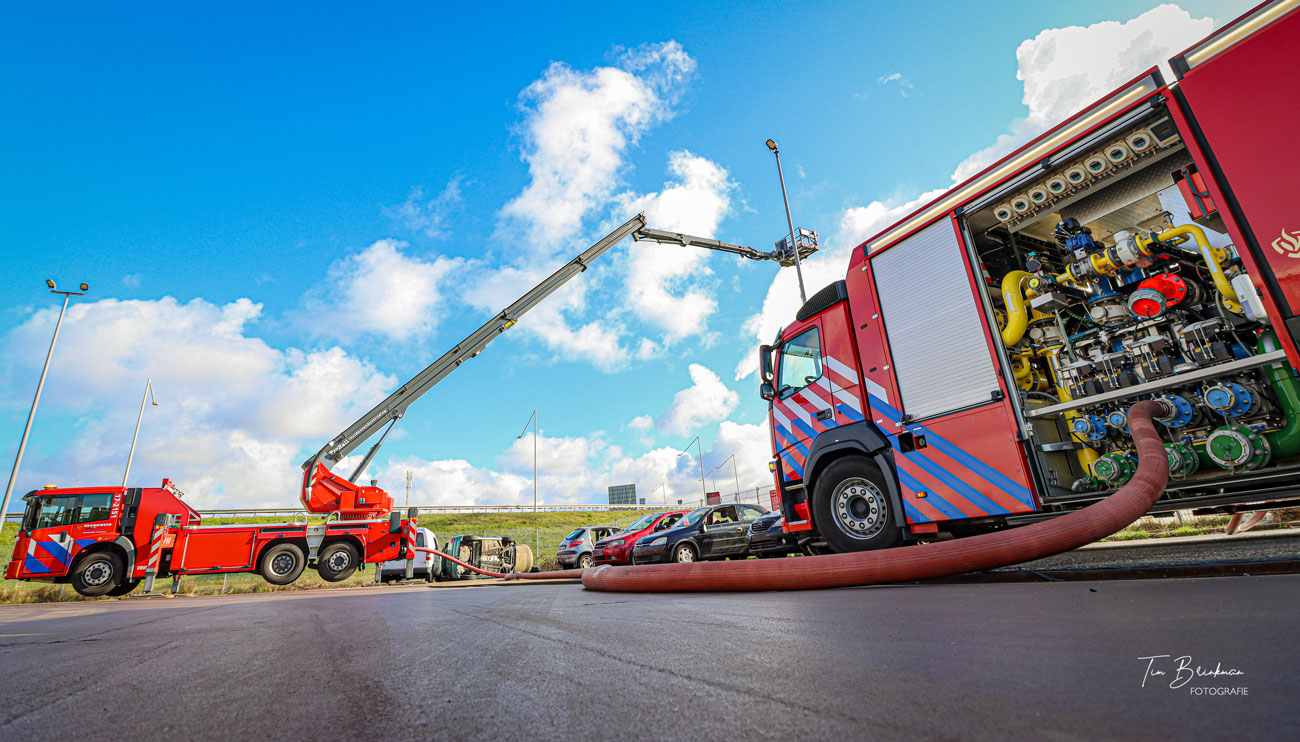
A second temporary facility in ProRail’s incident response area is an aerial platform especially purchased for extinguishing and cooling incidents on three elevated railway embankments, which are connected to Waalhaven-Zuid yard. The monitor in the basket of the aerial platform delivers a maximum of 3,500 litres per minute.
Fire water on yards: how much do we need and how fast can we make it available without the risk of water hammer?
Jack Konings, fire-safety specialist, ProRail
Renewal of the ‘firefighting fleet’
With the focus on the near future, the next investment in ProRail’s firefighting capacity is already planned. A lot of new equipment is expected in the coming years. The Rotterdam Joint Fire Brigade will replace its entire fleet of industrial firefighting vehicles over the next few years, some ten in total. In consultation with, and partly funded by, ProRail, two of these new extinguishing units will be equipped with a telescopic extinguishing arm, due to their deployment at specific locations on railway yards and raised railway embankments. Those extinguishing units will then also replace the recently acquired temporary aerial platform.
Major investments are also planned around marshalling yard Kijfhoek in the neighbouring safety region and municipality Zwijndrecht. After years of outsourcing to private company firefighting services, ProRail will set up its own company fire brigade here, which will have robust foam firefighting vehicles with an extinguishing arm at its disposal. ProRail Incident Response in Rijnmond, which now has 75 employees, is to be expanded with 25 firefighters specialised in industrial and railway incidents as part of this organisational upgrade. Substantial material investments and close collaboration between ProRail, the Joint Fire Brigade and the public fire brigade organisation in Zuid-Holland Zuid, will focus on being fully prepared for the low probability of incidents with potentially very high consequences. Adequate incident suppression and continuity of operations are top priorities. In such situations, it all comes down to preparedness, rapid response and solid understanding of the yards and trains. These conditions are secured with the investments made, now and in the years to come.
The frequency of normative fire and chemical scenarios on yards is low. But when it happens, we are prepared
Henny Kennedy, Manager operational preparedness & compliance
International comparison
Shunting yards are exempt from European Seveso legislation because no operations with hazardous substances are carried out at shunting yards. However, Rotterdam has strict requirements for the yards. How does this compare with other large railway yards in Europe and the United States? The lack of unified standards, guidelines and legislation are striking in a European market.
Europe’s largest humping yard, Maschen, south of Hamburg, is one of two yards in Germany to have a dedicated company fire service. The company fire brigade was enforced by the local municipal government through a court case in 1992 after a chemical spill incident in 1989. Since then, a team of professional firefighters has been on standby 24/7 on the yard. For fire-extinguishing water, Maschen has a ring main with some hydrants. In addition, the company fire brigade has a water truck with 70,000 litres of fire-extinguishing water. Furthermore, the company fire brigade has a hazmat team, a fire engine, an emergency vehicle and a crew vehicle. A limited amount of firefighting foam is available. There are no dedicated emergency roads between the tracks. The company fire brigade does not consider large chemical fires in the yard to be a credible scenario for preparation of the fire service. Maschen fire service cooperates intensively with the municipal volunteer fire service of Seevetal.
The Antwerp-North yard is the second-largest humping yard in Europe. The fire-extinguishing water supply consists of a number of one-way fire-extinguishing water lines, with a small number of hydrants. Fire water can be collected from large open waters on the yard. There is no dedicated fire service on the yard, firefighting services are provided by the Antwerp Fire Department. In recent years, Antwerp Fire Brigade has issued opinions on desirable fire-safety provisions, using international industry standards. These recommendations are under construction. Infrabel and Antwerp collaborate with BASF in the harbour in the operation of a Turbolöscher, a large fire engine that delivers enormous amounts of watermist over a long distance, based on turbine technology. BASF’s turbolöscher, has a capacity of 8,000 litres per minute and a sufficient throw length to reach the mid-tracks in the yard. Deployment and connection to fire water is done in collaboration with civil defence of Belgium.
The largest yard in the world is Bailey Yard. This yard is located in the small town of North Platte in the US state of Nebraska. The yard operator Union Pacific Railroad is primarily focused on incident prevention. The yard does not provide specific fifi-units for incident response and has only a few hydrants. Fire service and hazmat are provided by the North Platte Fire Department. In the past, various fires took place, of which a burning petrol tank (2012) and wagon with electric vehicles (2020) are examples. Shunting activities on the yard are not regarded a special risk to fires or chemical spills.
About the Author

Kees Kappetijn is a consultant at/owner of Kappetijn Safety Specialists. Philip Stohr is a consultant at Kappetijn Safety Specialists. The consultancy supports organizations with the design and establishment of Municipal and industrial emergency service organizations and is specialized in Mutual Aid initiatives in ports and industrial areas. www.kappetijn.eu. Kees Kappetijn and Philip Stohr are involved as policy and industrial safety experts in the UIFRS/Amsterdam project team.

David Pronk
David Pronk is a consultant at Kappetijn Safety Specialists (KSS). The agency consults firefighting organisations, Seveso companies and authorities in the fields of industrial safety, business continuity and emergency response. Issues related to industrial fire services, harbour safety and Mutual Aid/PPP is a specialty of the company. www.kappetijn.eu.