
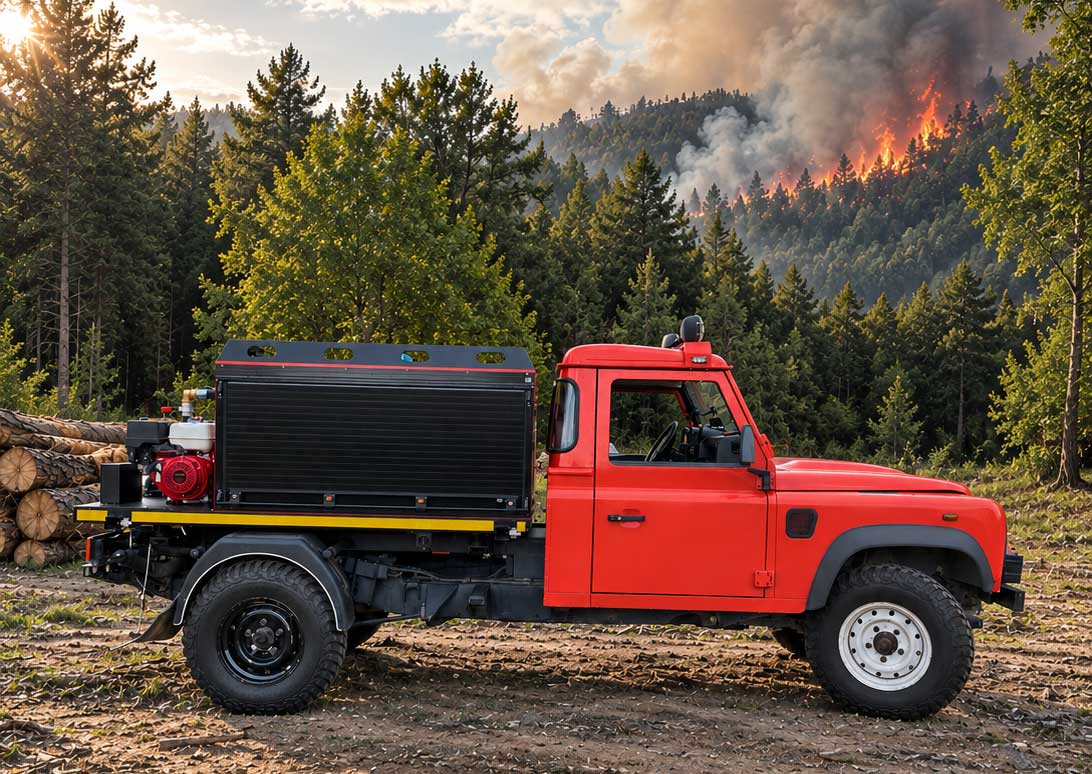
The company explores how the Tactical Unit module, Compact Tactical Unit, can turn classic Defender units into agile support vehicles for wildfire fighting.
Vallfirest, the wildfire company, has presented an opportunity around the potential of the classic Land Rover Defender (1983-2016) as the basis for a new generation of light wildfire response vehicles, drawing on a global fleet of more than two million units produced and an already fully professionalised restoration market.
The proposal starts from a key fact: the worldwide fleet of classic Defenders available is large but shrinking, as corrosion, accidents and abandonment steadily take units out of circulation. At the same time, a mature network of restoration and “restomod” workshops already exists — with benchmark builds ranging from $145,000 to $500,000, Land Rover’s own official Defender V8 Works Bespoke restoration programme, and a specialized auction platform that surpassed $1.7 billion in classic vehicle sales in 2025 — capable of returning these units to a level of mechanical and structural reliability suited to demanding use.
A tactical module built to fit the Defender
The technical starting point is the modular approach the wildfire response sector has been adopting in recent years to equip light trucks: instead of a single, closed fire truck, independent modules — tank, pump, hoses, tool compartments — are installed, capable of being mounted, removed, or adapted to different chassis depending on the mission. Vallfirest’s Tactical Unit modules, already deployed in various wildfire operations, follow this logic: built in polyethylene and steel, they can incorporate a medium-pressure firefighting kit, water tanks of up to 3,000 litres with internal baffles, storage units for protective equipment and hand tools, and an upper cargo tray. The mounting system allows the entire module to be removed from the vehicle in under five minutes.

According to Vallfirest, these features fit naturally with what the classic Defender offers: 4×4 traction and off-road geometry designed from the outset for narrow forest tracks, a chassis with enough load capacity for a compact-sized module, and compact dimensions that let it reach places a conventional fire truck cannot. Adapting the existing modules — sized today for larger light trucks — to a Defender chassis would require a more compact, redistributed version, but the same modular, made-to-fit design principle is what would make that adaptation possible. This new unit has been named the Compact Tactical Unit.
Adding to this is a relevant technical factor: the mechanical diesel engines that powered much of the classic production — such as the 200Tdi and, especially, the 300Tdi (1994-1998) — lack electronic management, which makes them particularly valued for their mechanical simplicity and low field maintenance. In terms of towing capacity, well-maintained classic Defenders are typically rated for up to 3,500 kg braked, a margin that allows additional equipment to be towed without compromising the vehicle’s own payload.
A logic already established in the bodybuilder sector
Refurbishing rather than replacing is not a concept foreign to the wildfire response world: various emergency vehicle bodybuilders and equipment manufacturers have for years offered their own refurbishment services to bring existing fire vehicles back to “like-new” condition, while also incorporating updated technology — a systematic alternative to buying a new vehicle, with clear advantages in cost, sustainability and operational continuity.
Four dimensions of value
Vallfirest sums up the potential of this reuse pathway across four dimensions:
- Operational: a more agile, compact vehicle than a conventional fire truck,
designed as a complement — not a replacement — to existing firefighting
resources. - Economic: a route to additional operational capacity with a lower entry
cost than acquiring a new vehicle. - Sustainability: a genuine second working life for an already-manufactured
vehicle, in line with circular economy principles. - Symbolic: the Defender, a worldwide byword for reliability in extreme
conditions, goes back to work — this time protecting forests and
communities.
About Vallfirest
Vallfirest is one of the leading companies in the manufacturing of protective equipment, tools, and solutions for the suppression and prevention of wildfires. The major wildfires occurring around the world demand new strategies and solutions. At Vallfirest, we actively work with analysts and industry professionals who share their needs and field experience with us. Thanks to this continuous flow of information, we have the knowledge required to develop disruptive solutions and provide professionals in the sector with the material resources needed to protect society and forest ecosystems from the negative effects of wildfires.
The world is facing the major wildfires of the 21st century, and at Vallfirest we work every day to deliver innovative solutions in the fight against wildfires.
For more information, go to: www.vallfirest.com
