
Fire season is coming and there are fewer people in the central west and far west of Queensland to meet the growing risk. How do we as the brigade representative association support those people with new and appropriate equipment?
Background
The Rural Fire Service in Queensland has approx. 3,700 x 500-litre slip-ons in service and about 400 x 1,000-litre trailers. These are great so long as you have people who can put them on their personal vehicles as it gives an immediate knockdown ability at fires and maintains control of the fires in the hands of the locals who understand how fire moves through their country.
This is why 60% of Rural Fire Brigades in Queensland don’t have a truck and most don’t want one.
Brigade membership as a percentage of population is still constant; however, with depopulation in the central west and far west there are fewer people. If we keep supplying the same small units, we will have fewer actually on the fire front. When they need to go refill, the fire gets a run.

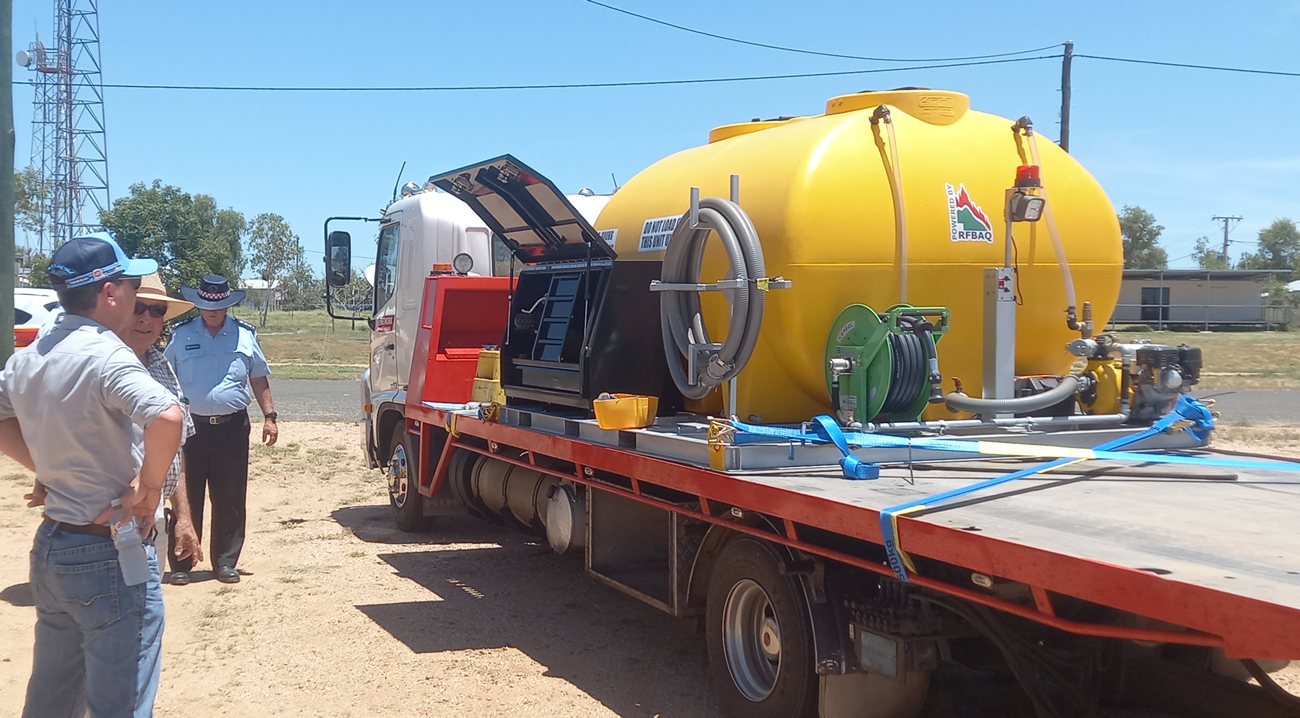
The proposed system and associated equipment that allows the local brigades to stay on the fire front longer is the supply of 5,000-litrel skid units and 2,000-litre trailers.
The skid unit is designed by the RFBAQ and built by Nu Tank in Rockhampton. Queensland economies run west/east and the supply and service centre for the central west is Rockhampton. By using a supplier that landholders already use in their personal/business lives there is a quicker product acceptance. The engine/pump combination is Honda/Davey. This is because most landholders already run this combination and if a swap out is needed locally, this can be sourced in most regional towns.
Units will be located at select rural fire stations and/or council depots, and at the commencement of fire season, local brigade members who participate will bring in a flatbed truck and have the 5,000-litre skid loaded onto their personal body truck. This will then be a resource to either fill up the local slip-on units or to knock down the flanks of a fire. Local councils will also be able to cart the units to support brigades at fires.
At the end of fire season, the brigade member will then bring the 5,000-litre skid into the local shire council depot or Rural Fire Brigade station, and the RFSQ will have the equipment serviced and safely stored under cover against the next time of identified need.
There will be no reduction in the current number of slip-ons or trailers with brigades; rather these will be an additional resource.
This will also for the first time build flexibility into rural fire and allow for the moving of assets to meet varying state risk. An example would be that if the central west was to return to drought and the gulf country was identified as having a higher fire risk, much of this new equipment can be moved easily.

User acceptance
Between 13 and 16 of February 2023 the RFBAQ organised tour with the Chief Officer of the Rural Fire Service Queensland made five stops – Ilfracombe, Jundah, Muttaburra, Barcaldine and Tambo – across four shires; met three Mayors, three CEOs and multiple councillors; spoke to truck and non-truck brigade Rural Fire Brigade members; covered 3,469km and saw a growing load of fuel following eight years of drought.
The RFBAQ are currently working with the Rural Fire Service Queensland and Nu Tank in Rockhampton to produce another 12 x 5,000-litre skids and have them in place with councils and brigades before fire season 2023.
The clock is counting down as fire season 2023 is coming and it will be a big one.
For more information please visit the RFBAQ website at https://www.rfbaq.org/ or email directly to Justin Choveaux at gm@rfbaq.org
