
Positive pressure ventilation (PPV) has undergone significant evolution since the introduction of battery-powered fans by BlowHard over a decade ago. This breakthrough technology facilitated cordless ventilation, eliminating poisonous exhaust emissions and fostering a safer environment for both firefighters and occupants alike. Today, battery-powered PPV fans have become the standard, broadening the range of environments where they can be used safely and revolutionizing PPV strategies.
The widespread adoption of battery-powered PPV fans has spurred other manufacturers to develop their own versions, yet one lingering drawback compared to gas-powered alternatives persists: power. Gasoline-powered PPV fans boast substantially higher horsepower, posing a challenge for battery-powered fans to match their volumetric airflow output. For some, the perceived need for such robust performance has justified retaining gas-powered PPV fans on firefighting apparatus.
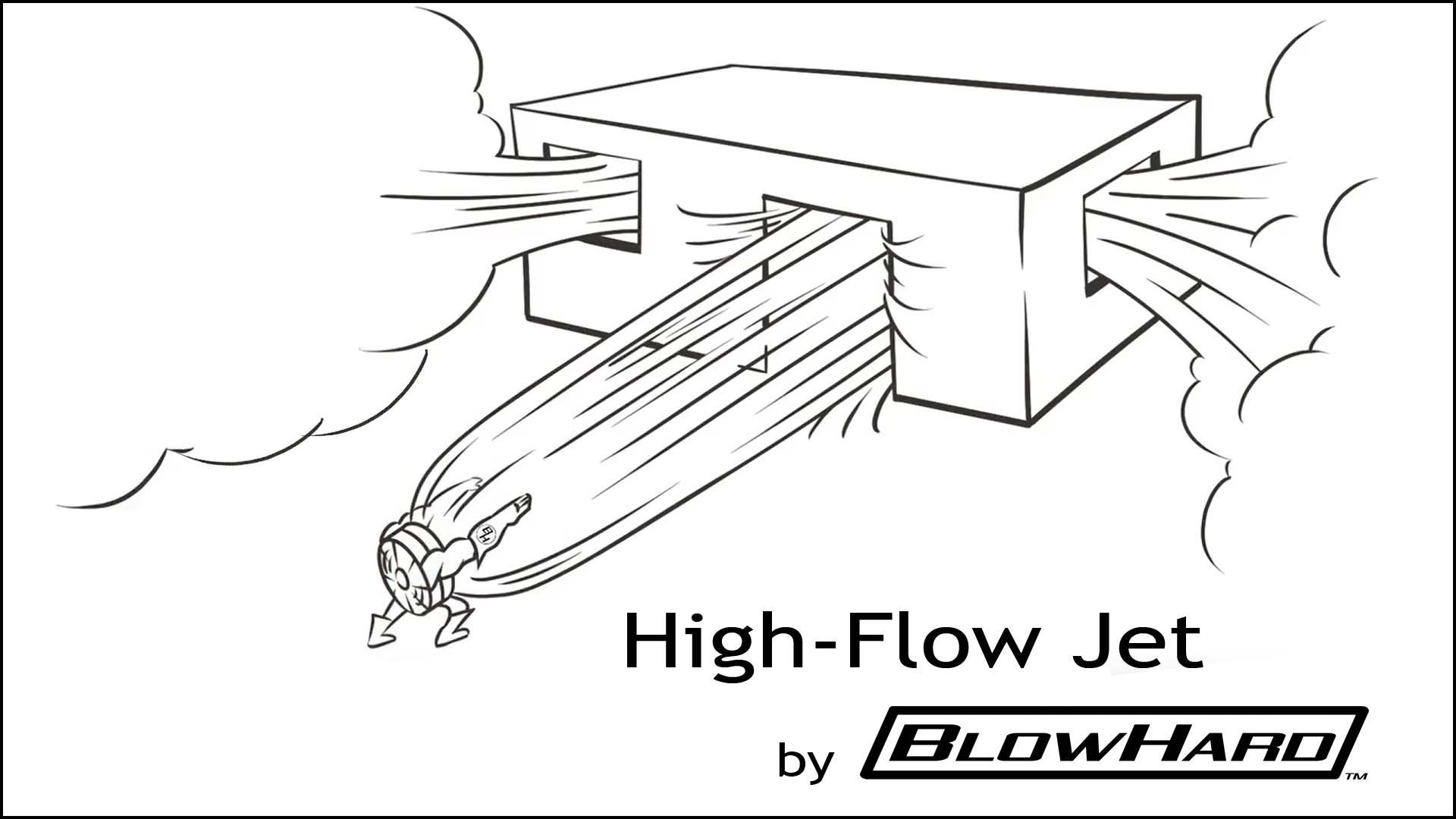
Innovative airflow: In efforts to provide a battery-powered PPV solution to truly replace gas-powered fans, BlowHard has worked to offer a robust solution. Leveraging the efficiency and effectiveness of large jet streams, BlowHard is able to stretch battery power further through the development of High-Flow Jet Technology. By maximizing the jet stream in proportion to the fan’s size, more air interacts with the surrounding environment, enhancing the volume of the jet stream and consequently increasing airflow into the structure. This larger jet stream also effectively seals off more of the entrance, reducing pressure-loss areas and driving airflow through the structure.
Size matters: High-Flow Jet allows a small fan to operate like a fan that is much larger. This effect allows BlowHard to provide ultra-compact fans that leverage the efficiency and effectiveness of fans that are much larger. In addition, BlowHard’s approach to fan design is to make the footprint of our fans almost the same size as our blade. The combination of High-Flow Jet and innovative design practices allows fans that are highly effective in an ultra-compact form.
Performance requires power: Increased power translates to higher velocity, bolstering the thrust into the structure and amplifying entrainment. Large batteries are required to produce high power. The combination of BlowHard’s High-Flow Jet and large batteries to produce high power yields an impressive performance density.
Performance density: The result of an ultracompact design combined with high performance is high performance density. Performance density measures the amount of performance produced as compared to the size of the fan. BlowHard’s High-Flow Jet, highly portable and compact design, and high-power performance provides an effective and compact solution that can truly compete with gasoline-driven fans. Ultimately, real-world performance hinges not only on the fan’s capabilities but on its ability to exceed the pressure within the structure. If a fan fails to surpass the pressure of the structure fire, then effective ventilation cannot be achieved.
Enhancing the performance of battery-powered fans necessitates advancements in both battery capacity and jet-stream size. Traditionally, such enhancements have led to larger fans requiring more storage space and greater effort to transport and deploy. However, BlowHard’s High Flow Jet Technology is leading the charge by delivering highly effective ventilation capabilities in a compact, portable package. Size and weight are crucial considerations in firefighting equipment, making this an attractive and popular benefit. With numerous tools required on the apparatus, minimizing storage space allows for additional life-saving equipment to be accommodated. A well-balanced, lightweight fan can be easily transported over challenging terrain and swiftly deployed.
With BlowHar’’s High Flow Jet technology, high performance density is achieved, ensuring optimal effectiveness in ventilation operations. Simply put, you get a small fan with all the advantages of its size, yet the performance of its larger counterpart – without the gas pains.
[Caption]
BlowHard expanded jet stream – High Flow Jet.
