Wildland firefighting and the importance of ’all-day’ comfort
Wildfires now affect the United Kingdom more frequently and since 2012 have been included in the national risk register of events which public bodies and businesses should be preparing for. During 2022 more than 20,000 hectares of land was burned due to wildfires. On 19 July 2022 Fire Services had to attend more than 800 individual fires in England alone.
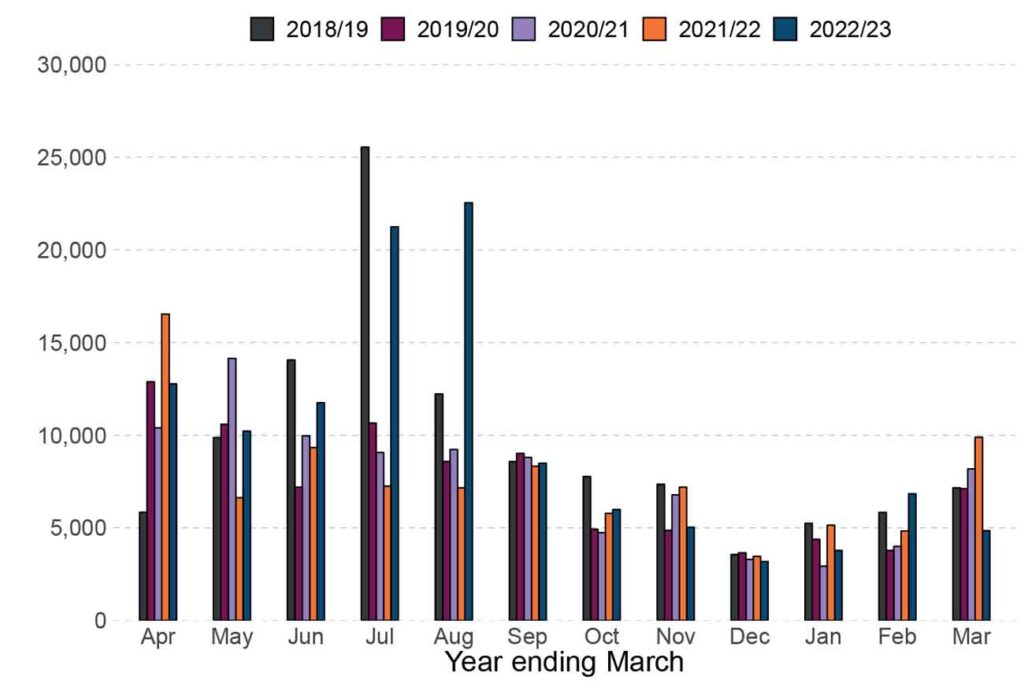
Data shows that there were 244 outdoor fires* a day in February 2023, contributing to approximately 6,000 in total that month.1 The full year (April 2022 to March 2023) shows that outdoor fires start to become more common in April, peaking in July/August with a drop from September extending through the Autumn and Winter months until only late March.
How resilient is your organisation to wildfires?
English data – the most recently available of that published by our four Home Nations – shows that the average 320 daily outdoor fire incidences were the second highest recorded since 2010/11 and running somewhat higher than the 13-year average of 275. There is little question, then, that our firefighters are increasingly likely to attend an outdoor or wildland fire during the long five-and-a-half-month season.
The exceptional increase in both categories can be linked to the hot, dry summer of 2022, the joint hottest summer on record equalling that of summer 2018. The increase was largely driven by the 44,150 grassland, woodland and crop fires in the year ending March 2023, an increase of 72% (25,620) compared to the previous year.
Figure 2.1: Outdoor fires attended, England; year ending March 2018 to year ending March 2023
That fires are more common in the hot summer months, and that they are occurring more frequently, is no surprise. Our changing climate, increased popularity of outdoor activity post-Covid and an increase in crime and disorder will have all contributed to growing numbers of outdoor fires.
What is more surprising is the total number of outdoor fires compared to those defined as ‘dwelling or other building fires’. In England in 2022/23 a total of 4,831 daily fires (including road vehicle fires) were recorded of which 1,436 were in dwellings or other buildings. Wildland fires alone account for 1,567 per day – almost the same number as dwelling fires.
These statistics raise the question of the suitability of currently issued clothing and the frequency with which we expect our firefighters to wear heavy tunics and trousers, sweaty gloves and bulky helmets, outside, in the sun, often in very hot and dry conditions.
A fresh approach to head gear
In the 15 years our Company has been supplying helmets to the UK Fire and Emergency sector, we remain surprised at how limited the introduction of lightweight helmets has been. It is universally accepted that the vast majority of modern firefighting does not involve entry into structural fires. As evidenced above, most fires are outside. Add to that confined space, non-fire RTCs, general non-fire and other technical rescue incidents and it becomes clear that there is a reducing need to issue every firefighter with a full structural fire helmet.
High costs and a lot of neck ache
Structural fire helmets are expensive and heavy. The EN4433 norm for structural fire helmets was updated back in 2008, resulting in manufacturers needing to design heavier helmets to protect, among other hazards, against heat, impacts and electrical hazards. Such a product is exactly what you’d want to be wearing when entering a building, clad in a fire-protective fire suit, chunky gloves and breathing through an SCBA set. However, worn during an outdoor fire in stifling August heat all day on moorland without shade, a structural fire helmet is not ideal.
Neither does an EN443 helmet come cheap. With costs of up to £350, providing this type of helmet for every wearer is very expensive.
A lighter alternative
Thankfully, there are alternatives. Recent, more appropriate standards for wildland firefighting helmets that allow for far lighter helmets – more akin to climbing and line work helmets – are now established on the market. These are tested for more relevant factors such as radiant heat protection, impact safety and ventilation. The norm BS EN 167414 describes these requirements including important elements such as flame-resistant head cradles and straps as well as details on the need for EN 144585 face masks and visors, without which any firefighting or rescue helmet is non-compliant.
These types of helmets are lighter, more compact and less expensive than EN443 helmets, often costing as little as £130.
Muti-use and cross-discipline products
Those in the know about professional rescue helmets and their applicable standards will know that a related and very similar standard – EN164736 (Technical Rescue Helmets) – is also in existence. At the risk of really confusing the reader with EN numbers, we reference this as these two standards are so similar that several manufacturers now offer a combined Technical Rescue and Wildland Firefighting helmet. A greater argument then, surely, for serious consideration to be given to issuing all UK firefighters with such a product?
Is decontamination an answer? This article supports the argument that lighter helmets should be issued to all firefighters – ideally a helmet suitable for all non-structural fire incidents. But how to afford it? How about by reducing the amount of structural fire helmets in use?
If those heavy and expensive helmets were only used when donning BA for structural or building fires, perhaps we could move towards pooled structural helmets? With the increasing focus on decontamination and the need to effectively clean all PPE after every particulate fire, every structural helmet should be cleaned after every fire. So why then not share them? Would reducing the number of heavy helmets mean more budget for more comfortable and more appropriate headwear for all firefighters for use at the majority of incidents?