
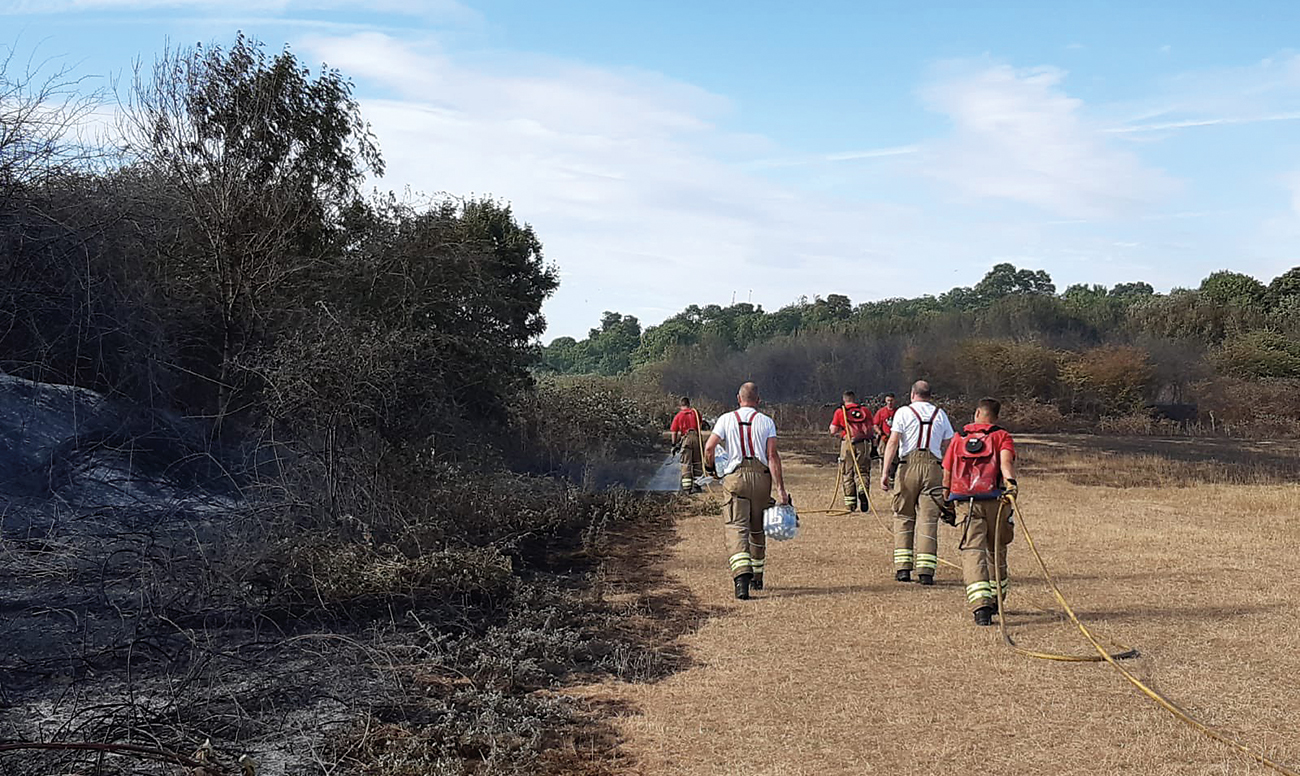
Increasingly frequent hot summers in the United Kingdom and fewer fire and rescue service resources are beginning to have an impact we couldn’t imagine a couple of decades ago.
For those of us who work in the world of regulatory fire safety in the UK, the first thing we do with clients is look at the risk from a fire starting, reducing the risk from ignition sources such as poorly maintained electrical items, smoking and even arson prevention. The second thing we look at is what may be termed in the industry as ‘housekeeping’, reducing the fuel, the things that can burn. Reduce those to a functional minimum, so don’t keep excessive raw material close to process areas, empty your bins, clean up the wood shavings or oil spills in a workshop.
Once that risk, the actual risk of a fire starting (ignition source) and growing (fuel load), is reduced to as low as reasonably practicable, only then do we turn to the protective measures such as ensuring fire exits are maintained, fire-detection systems are adequate and so on. There is a duty for the ‘Responsible Person’ for pretty much every public and commercial building in the UK, including offices, shops, theatres, hotels, factories warehouses etc. to do this under the Regulatory Reform (Fire Safety) Order 2005.
Unsurprisingly, there is no duty to do this in the home and rightly so. The Fire Service carry out their ‘community safety’ duties very well, advising us to have an escape plan, fit smoke detectors on every level of our homes, not to overfill chip pans or overload electrical sockets. Their success in this over the past two decades has seen fires and fire deaths in the home fall considerably. But I for one, as a former firefighter and fire safety professional, would take issue with a fire-safety inspector telling me (before my wife does) to pick up the trainers I left on the stairs, as they are blocking my escape route, or checking my ‘records’ to see that I’d changed my smoke detector batteries and had carried out a six-monthly fire drill with my family.
However, the awful fires across the UK this past summer and in particular those at Wennington and Dagenham, close to the London/Essex border, have demonstrated that maybe, for our own good, we need to think beyond the overloaded plug sockets and smoke detectors and also cooperate and coordinate (another duty of the Fire Safety Order) with our neighbours, whether they be residential or commercial, for everyone’s benefit.
You’d be surprised at the number of innocent fires that start in gardens. From bonfires, barbecues, a compost heap, or some other act or omission. Even out of the summer season, London Fire Brigade’s Twitter feed will give advice on the above following a garden fire that spread into residential properties several times a year. Bins and sheds close to the house, unwanted combustible items in close proximity and overgrown vegetation all add to this risk.
We’ve all seen reports of vast wildfires in Europe and the USA that consume entire streets, villages or towns. That spectre visited us in London this summer with outdoor fires burning into gardens and their contents and then into multiple houses. This is certainly the first time it has happened in our capital city. Grass fires in summer are nothing new, during my career, the long hot summers of 1995, 2003 and 2018 as well as the hot dry early summers of 2005, 2006 and 2013 saw me and my colleagues running from one fire to the next way out of our local area toward the outskirts of London as fields, country parks, heathland and commons went up in flames.
I am not going to get into a debate on global warming or climate change. I am not a denier by any means, but it isn’t my area of expertise. What I do know is that we went 19 years between the much-celebrated summer of 1976 until 1995, which was the next record-breaking prolonged summer. I do recall 1983 being hot and my first ever professional awareness of grass fires was in 1990, when having then been a Firefighter for three years, it was warm and dry enough that I attended a handful of grass fires. From 1995, we only waited eight years until 2003, which saw a record-breaking heat wave across Europe including the UK where 100F was reached for the first time on 10 August. By that time, I was a senior officer and I spent quite a lot of that summer attending grass or gorse fires across London, including Wanstead Flats, Dagenham, Hornchurch, Upminster and Epping Forest.

In 2005 and again in 2006 the spring had been particularly dry and early summer pretty warm in the SE of England so Firefighters in the region were called upon to fight frequent wildfires. In May 2011, again due to a dry spell, Swinley Forest in Surrey suffered a major fire, which required back up from crews from places as far flung as London and Wiltshire, I was there overnight on the second day coordinating eight LFB crews drafted in to assist.
In July 2013, I was attending the Royal International Air Tattoo at RAF Fairford in Gloucestershire on behalf of LFB, when I was paged to urgently return to London as they were running out of senior officers due to several large grass fires depleting numbers among a handful of other serious fires in London that evening.
So, whatever your beliefs on global warming or climate change, it is indisputable that the frequency of hot dry summers in the UK is on the increase and with that the number of fires and pressures on a much smaller fire service to deal with them. This is where 2018 is much clearer in my memory and better for analysis.
Like some of those previous summers, 2018 was a reasonably dry and warm spring as I recall, after a relatively dry but cold winter, which included the ‘Beast from the East’ in late February to early March of that year. Late March onwards was quite pleasant, for some reason, the numbers of fires overall increase when we have these warm and dry spells. As the weeks went on and the clock ticked down toward the last days of my time serving in LFB the number of fires of all origins in all types of buildings seemed to increase. These were not all down to heat-related events like dried-out timbers being ignited by an errant spark, golden grassland falling victim to a dropped cigarette or a mirror reflecting bright sunlight onto a pair of bedroom curtains. Fires just seem to increase.
But some inevitably are. It isn’t just the grass and heathland with their tinder-dry contents ready to ignite from the slightest ignition source; it seems to be the general heating and drying of all sorts of material in a wide range of premises, as well as windows left open giving a greater air supply to a growing fire. Added to this are other microbial or chemical reactions going on in things like wood piles or compost heaps that can heat up to the point of ignition. Electrical items, especially those that are designed to keeps things cool have to work harder and as a result can overheat and start a fire.
One by one, day by day, the fires increase. Firefighters are called to a fire, the next one starts, but the local Firefighters are elsewhere dealing with the first fire so that fire gets a bit bigger before Firefighters arrive from further afield, and it all begins to snowball. More fires, fewer Firefighters available locally, the bigger they get, the more Firefighters required to tackle them, more areas depleted of cover.
Summer 2018 certainly followed this pattern: I was in command of or attended serious fires almost every day of the week from high-rises to warehouses and shops.
Then I had the biggest grass fire London had ever seen, on Sunday, 15 July 2018, just before I retired. I was called to a familiar address where I’d attended many heathland fires over the years. Wanstead Flats, in East London. As I arrived, the crews in attendance were desperately fighting the fire which had jumped the road and was moving toward houses to the West on the wind as well as spreading by radiated heat to the SE of its origin. I came across a colleague who asked me to take the Eastern flank, gave me a couple of crews already in that general area and asked me to get back to him with my requirements.
I ended up at the very edge of where the fire could reasonably burn, where the football pitches started and where the fire, if it did spread, would be in dried grass just a few centimetres deep and much easier to extinguish. The big risk though, was a tree line with a block of flats and a petrol station behind it. I had by then eight crews with me and as hard as it was, I declared we should wait for the fire to burn to us, where the gorse changed to cut grass and leave the greater number of those resources protecting the large tree line that led to the block of flats. We won the battle, the fire had by then increased to 40 pumps and covered an area of approximately 100 football pitches of long grass, gorse, bushes and trees in a peaty soil, which burned below the surface.
A week later, on my last ever shift, I attended my last ever fire, which was a grass fire at Woolwich Common in SE London. Again, an innocent small fire had spread rapidly in multiple directions threatening local wildlife as well as surrounding properties.

In the future, I think we are going to see an increase in long, hot summers and the increased pressures this brings to our firefighters. Fire crews today, even in large metropolitan fire services such as London, are better equipped and trained than they were a generation ago for this type of incident. But (in London Fire Brigade) we certainly don’t have specialist offroad firefighting vehicles to assist us.
They, like all fire engines, are incredibly expensive specialist vehicles that have limited use in day-to-day firefighting. But that doesn’t mean LFB could not procure regular pumps with a narrower width and an off-road capability to be placed at strategic stations where they know these fires occur year in year out.
In some of the more extreme rural locations, such as Dartmoor, Wales and Scotland, private helicopter contractors are retained with pilots specially trained to carry ‘Bambi buckets’, the 500/1,000-litre bucket slung beneath helicopters, filled with water and fire retardant, which we see used all over the world to stop the leading edge of an out-of-control wildfire.
I really feel that this capability should be in place across the UK regionally in the future. There are also a limited number of wildfire tactical advisors throughout the UK fire service, and I am led to believe there are only three in London. This number needs to be expanded. Once more are trained, crews should receive more detailed and proactive training such as lighting counter fires or backfires, where crews literally fight fire with fire, lighting fires to burn in a controlled way toward the main body of fire to deny it the fuel to grow and spread further, and be equipped with chainsaws to cut fire breaks or being able to utilise agricultural machinery for the same purposes.
So, what about us, the public and Local Authorities? Going back to the Fire Safety Order, we should, and generally can, live our lives in our homes without harassment by the state. But it wouldn’t hurt for us to consider our neighbours, whether you are the owner of a stables or car-repair business that backs onto residential premises, or whether your house backs onto a school field. Should we consider fire safety? I know almost everyone, myself included, has a fear of crime, and where our gardens back onto open or accessible spaces, we love big thick prickly Hawthorn, Berberis, or Holly bushes to protect us from unwanted visitors, but do we consider keeping it trimmed and well watered so it doesn’t become a rapid fuel parcel spreading the adjacent grass fire to our fence, then shed and finally our house?
We also really need to consider the use of barbecues on common land. It isn’t right to deny those who don’t have gardens the right to a barbecue, but local authorities should invest in fire safe picnic/barbecue areas in parks that are regularly patrolled with closed bins for hot coals separate from general waste bins. There is also a duty to ensure that green spaces are adequately maintained and the dead foliage from previous winters is not sitting there as additional fuel for the following hot dry summer.
In summary, my heart goes out to all of those people who have lost their whole world in the fires this summer. My eternal respect goes to my former colleagues who went from fire to fire, without a break, in immense heat, often forced to wear full structural firefighting kit and heavy breathing apparatus because fires had spread into buildings. It is unimaginably exhausting and saps the strength of even the fittest in a matter of minutes. But I am grateful for the media coverage and the chance to bring this discussion to the front to educate people that fires don’t just happen to other people; they can happen to you, whether as a result of a small fault in that brand-new expensive dishwasher or from a fire that doesn’t even start within your home but destroys it from the outside.
For more information, email steve@ignisfire.org.uk
