
It is a rare firefighter who, in the excitement of a fire event, thinks of a fire scene as a place filled with valuable forensic evidence. Although we may think of the fire itself as the reason evidence is destroyed or compromised, the activities of firefighters and first responders can be just as damaging to physical evidence. Unnecessary evidence alteration or destruction can impair the ability of governments and others to determine the origin and cause of fires and to resolve the legal proceedings and disputes that result. In extreme cases, it can expose the agency to criticism, negative publicity, and potential legal action.
Most fire safety professionals know that the causes of fire must be understood so the public can be educated how to prevent future incidents, and so safe and reliable products can be designed and sold. Understanding what causes fires depends on good fire investigation, which includes a thorough analysis of all of the physical evidence at a fire scene.
Every fire investigator from any agency or business should receive training in identification and preservation of evidence, whether or not the investigator’s duties include evidence handling. Just as important, firefighters and first responders to a fire scene should also be trained on actions they can take to avoid compromising the evidence that is needed to make a just, accurate determination of the cause of a fire.

Firefighters and First Responders
Fire scenes are often attended by first responders other than the fire department, including industrial fire brigades, police, private security, and military. It is easy to picture the ways in which a first responder could innocently compromise physical evidence. Firefighters and hoses move freely through burnt and unburnt areas of a scene. Personnel enter scenes with tools that run on petroleum products like gasoline, potentially transmitting those products to fire debris. People walk through fire scenes out of interest and curiosity, bringing potential contaminants in on their shoes and clothing.
Training for these responders can be provided by the agencies responsible for the investigations in their jurisdictions. It should include the importance of fire evidence in the legal system, recognizing items that might constitute physical evidence, ways to mark and report locations of evidence, and the ways in which contaminated clothing, footwear, and equipment (as well as the activities of ordinary firefighting) might compromise fire evidence.
Understanding that suppression and overhaul activities are necessary in a fire scene, firefighters should follow the following guidelines to assure that they do not contribute unnecessarily to compromise of evidence:
- Recognize that physical evidence may exist anywhere in a fire scene, whether or not the area in question has been affected by fire. Take efforts to not disturb or move property, turn switches and knobs, or examine objects or appliances without good reason. Things that do not seem like they should be evidence could nevertheless be important to the investigation.
- When possible, extinguish fire with minimally necessary amounts of water, and restrict the search for fire extension (“overhaul”) to only those activities needed to assure that the fire has been located and extinguished. Avoid the temptation to remove property or otherwise clear the scene or the fire room without approval from the investigator.
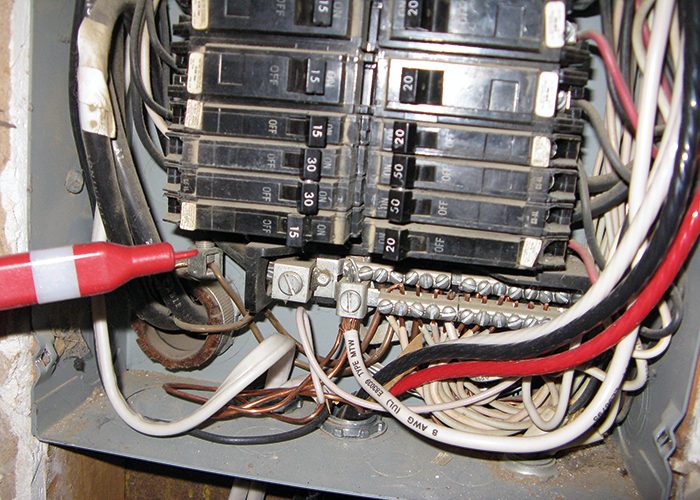
- When electrical circuit protection must be turned off to protect people or property, do so in a way that preserves branch circuit protection for inspection by investigators. For example, circuit breaker panels often have “main” breakers that control all of the circuits in the panel. Switching the main breaker off allows the branch circuit breakers to remain in the position they occupied before the arrival of responders, affording valuable information to the investigator. If possible, prevent utility personnel from removing parts of the system, such as gas appliances and meters, until they are inspected by investigators.
- Take extra care to not bring petroleum products such as gasoline (petrol) into the scene. Refuel tools away from the fire area, and if possible, avoid using power tools in the heaviest areas of fire damage. Heavy motorized equipment should not be used on a fire scene without prior consultation with the investigator.
- Restrict personnel who enter the scene to those whose presence is necessary to accomplish suppression of fire. Department personnel can be posted at entries and exits to keep track of who has been in the fire area.
- Protect items that appear to be potential evidence by marking their location, diverting personnel away from them, and bringing them to the attention of commanders and investigators.
- When possible, maintain walking pathways through fire scenes. This permits personnel to work within a scene while preserving most areas from being compromised by travel. Similarly, pay attention to where hoses are moving, and take efforts to prevent hose streams, as well as the hoses themselves, from doing unnecessary damage.
The International Association of Arson Investigators (IAAI) encourages the training of firefighters and first responders in preservation of evidence. The organization, composed of 8,300 public and private investigators, engineers, scientists, and insurance personnel from 66 countries who are involved in the investigation of all types of fires, has published a video that describes steps that can be taken by firefighters and first responders to help preserve fire evidence for later investigation and inquiry. The video is accessible on line at: https://www.firearson.com/Publications-Resources/First-Responders-DVD.aspx

Investigators
Depending on the jurisdiction, public authorities may or may not be involved in the investigation of a given fire. Many fires are investigated by privately employed investigators or engineers. Some investigators handle and collect evidence, while others are obliged to alert police services for handling. In yet others, the close examination or forensic testing of physical evidence may not occur unless there is a legal process or insurance dispute, necessitating the involvement of privately employed investigators.
Investigators without the proper training are at great risk of compromising the evidence physically, and/or of being unable to demonstrate that it remained intact up until the time of testing or presentation in court. For example, trouble can arise if an investigator uses unclean tools or containers to collect fire debris; uses a container that is not appropriate for the type of evidence involved; disconnects electrical evidence at an incorrect point in the circuit; fails to use new gloves and clean tools for each collection of debris; allows his or her DNA to mix with samples being collected; inadequately documents the chain of custody of a piece of evidence; or stores and transfers evidence inappropriately.
The U.S.A.-based National Fire Protection Association (NFPA) promulgates consensus-based standards and codes relating to fire and life safety that are recognized and followed in many parts of the world. NFPA 1033, Standard for Professional Qualifications for Fire Investigator, addresses the expectations for fire investigators in all sectors of the industry as to the preservation and collection of evidence with several job performance standards.
All agencies and businesses employing fire investigators should provide and encourage training that follows the roadmap provided by NFPA 1033. Credentials and certifications for fire investigators should include testing on evidence topics. The credentials offered by the IAAI are becoming widely recognized in the world, and are based on the standards of NFPA 1033 and the prominent investigation guide, NFPA 921. These credentials include testing on evidence topics.
One IAAI credential, Evidence Collection Technician (ECT), includes a practical test in which the candidate collects and packages a variety of types of evidence (such as ignitable liquids and fire debris) with a proctor who uses a procedural checklist to verify that the candidate has successfully performed the requisite elements of safety, skill, contamination prevention, and chain-of-custody documentation. The candidate who passes the ECT comes away with a credential that attests unequivocally to his or her evidence collection and preservation skills.
Regardless of the source of the training, education of fire investigators should include at a minimum the following:
- Decision making as to whether evidence should be collected
- Appropriate tools for evidence collection
- Importance of cleanliness of tools and equipment
- Cleaning methods for tools and footwear
- Contribution of uniforms and boots to evidence compromise
- Collection methods for fire debris, fireworks and incendiary items, ignitable liquids, clothing, blood, DNA, toolmarks, electrical items, and other categories
- Appropriate containers for the different types of evidence, and the different types of tests that might be necessary
- Handling of electrical evidence
- Appropriate documentation of the evidence collection procedure
- Appropriate handling, storage, tracking, and transmittal of samples
Investigator training includes modules available on IAAI’s free web training platform, www.CFITrainer.net.
Conclusion
Public safety is enhanced when the causes of fire are determined, and proper fire investigation is the key to determining causes. When fire evidence is preserved, there is a far greater likelihood that a fire investigation will be successful, and that later governmental inquiries or legal proceedings will be well-informed. Agencies and businesses should assure that their personnel are well trained in identifying, preserving, and where appropriate, collecting and storing fire evidence. Such training is essential not only for investigators, but for all personnel who respond to fire incidents.
For more information, go to www.firearson.com www.cfitrainer.net
About the Author

George A. Codding volunteers as a firefighter and fire investigator for a fire department in Colorado, U.S.A., and works as a prosecuting attorney for the state government. He has served as chair of a multi-agency investigation team. He is a member of the International Association of Arson Investigators (IAAI), where he has served as a committee chair, text reviewer, chapter president, and director. He is currently First Vice-President of the IAAI, and will become President in April, 2016. He has a Juris Doctor law degree, and holds the IAAI’s Certified Fire Investigator (CFI) certification. He has published several articles on legal and investigation topics, and has presented on legal, methodology, and investigation subjects in English, French, Spanish, and Portuguese.
