
Various Australian Royal Commissions, State Inquiries, research publications and opinion pieces have all acknowledged the potential benefits associated with rapid initial attack (or Pre-Determined Dispatch) by aerial firefighting aircraft in the early stages of bushfire incidents. Benefits speculated have included quicker containment of bushfires whilst they are small creating safer work environments for firefighters and minimising costs associated with suppression, fire damage and recovery.
The South Australian Country Fire Service (SACFS) has operated a Rapid Initial Attack Strategy for over 25 years; however, little evaluation has really been undertaken to determine the effectiveness or benefits of this model. The establishment of a new Primary Response Zone (PRZ) in the states Mid North which commenced operations at the start of the 2018/19 Fire Danger Season provided a unique opportunity to undertake this type of analysis through direct comparison of incidents involving rapid initial attack of aircraft against historical incidents where aircraft were dispatched to the area based on request.
The South Australian Rapid Initial Attack Strategy
Research by the Australian Bushfire Cooperative Research Centre identified that for an aircraft to provide effective assistance, it must be available at call, rapidly dispatched with minimal travel time, and supported by logistical systems in place.
SACFS has integrated these principles into its rapid initial attack strategy through:
- Exclusive use contracts for a fleet of suitable aerial firefighting aircraft.
- Standard Operating Procedures (SOPs) which prescribe preparedness and response of those resources.
- PRZs with realistic geographical parameters designed to minimise aircraft travel time and ensure arrival ‘over a bushfire’ within prescribed timeframes.
- A network of strategically located airbases with supporting infrastructure designed to increase fireground productivity through reduced ‘turnaround’ times for reloading of fixed-wing firebombing aircraft.
The core of the strategy is the standby and dispatch of aerial firefighting resources within PRZs, which are defined geographic areas of high bushfire risk where uncontrolled fires may have serious consequences for life, the community, and environmental or commercial assets. PRZ boundaries are based on distances of approximately 25 nautical miles (46km) radius from a Nominated Operational Base (NOB), to ensure a higher probability of initial attack success, given that aircraft travel time and distance from fire are factors in the effectiveness of aerial firefighting suppression.
When on active standby (the trigger being predicted Fire Behavior Index ≥ 22), aircraft are automatically dispatched to any reported rural fire in the PRZ simultaneously with ground resources. The minimum aircraft response package is comprised of two Single Engine Air Tankers (SEATs) in company with an air-attack supervision platform and an air observation platform. Aircraft packages across all PRZs in South Australia are (where possible) enhanced by two supplementary SEATs to provide additional weight of attack on days of predicted Total Fire Ban (TFB).
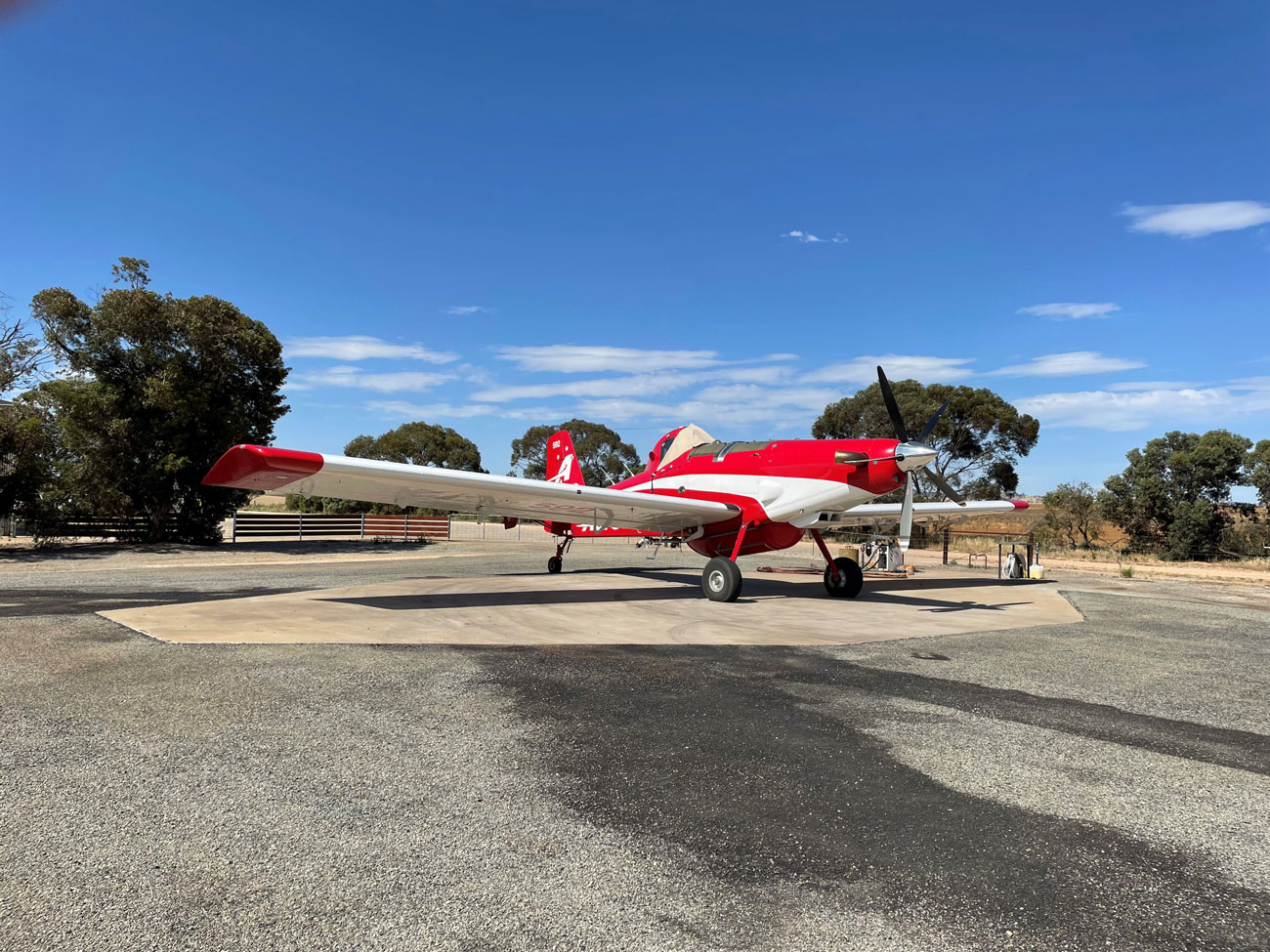
Selection of aircraft types to resource a rapid initial attack strategy is central to its success. For the Mid North PRZ where there are limited open-water supplies, fixed-wing SEAT aircraft provide firebombing capability based on their mobility and ability to operate from any airbase within the SACFS network (Figure 1). They also offer operational flexibility to the strategy by being approved to deliver all types of aerial firefighting product (class A foam, water enhancer and long-term retardant) used by SACFS.
A pair of Type 3 helicopters provide the air attack and air observation platforms as they can transit to an incident in company with SEAT aircraft and operate for long periods over a fireground whilst affording an ergonomically comfortable environment (Figure 2). They also provide capability for fireground pick-up of key personnel (e.g. Operations Officers or Divisional Commanders) for reconnaissance and validation of strategies and tactics.

All bushfire-prone areas outside of the recognised PRZs are defined as the State Response Zone (SRZ), where the primary function of aerial firefighting resources is the provision of support to extended attack and large bushfire support. Dispatch of aircraft into SRZ areas is based on a specific request by an Incident Controller and assessment and approval at the state level.
The Mid North Primary Response Zone (PRZ)
Nearly 50% of all SRZ aerial firefighting aircraft dispatches in South Australia between 2011/12 and 2016/17 were to bushfire incidents in the Mid North Fire Ban District, including the devastating Pinery fire in November 2015 which burnt 82,500 hectares and resulted in two fatalities, 91 homes destroyed and insurance costs of more than $60 million. The Mid North region includes major tourist areas of the Clare and Barossa Valleys, rich agricultural land for farming (i.e. cropping and livestock production) and award-winning vineyards. Mixed cropping accounts for around 431,600 hectares of land in the region, with predominant crop types including wheat, barley, canola and lentils.
Based on this data and population change in the region leading to declining volunteer firefighter numbers placing a greater need for aerial firefighting aircraft to assist with containment of bushfires, SACFS received funding to establish the Mid North PRZ. The Mid North PRZ encompasses a geographic area of 9,440km2 (Figure 3), with the Nominated Operational Base (NOB) for aircraft located at Hoyleton (20km south-east of the township of Clare) supported by a network of reloading airbases operated by volunteer Airbase Operators who are responded as required.

Results of the analysis
An analysis of 194 incidents involving the rapid initial attack of aircraft in the Mid North PRZ against 44 historical incidents where aircraft were dispatched to the district based on SRZ specific request procedures was undertaken to gauge any benefits of the strategy. The following is a summary of the results of the analysis.
Has the strategy provided a ‘rapid’ response?
The analysis showed that the rapid initial attack strategy produced mean response time from aircraft dispatch to first arrival of 15.4 minutes, with 100% of response times falling within the critical 30-minute ‘window’ associated with increased probability of bushfire containment success. This data also confirmed that aircraft type selection was suitable for the geography and dimensions of the PRZ boundary.
Has the strategy kept ‘small bushfires small’?
The analysis highlighted that the rapid initial attack strategy contributed to a 96% reduction in mean final fire area sizes from 342.73 hectares to 14.37 hectares, with 98% of incidents being contained to under 100 hectares.
Is the strategy cost-effective?
Having ascertained that the strategy has led to a reduction in fire sizes, its cost effectiveness was determined through a comparison of the potential wheat crop damage ‘saves’ against actual aircraft costs (standing charges and hourly operating costs) associated with aerial firefighting resources in the Mid North PRZ (Figure 4).

Figure 4: Comparison of potential wheat crop damage reduction and aircraft costs (daily standing charges and actual hourly operating costs for incidents attended) for the Mid North PRZ.
The analysis indicated that for each year since the PRZ was established, the potential wheat crop damage ‘saves’ provided by the strategy, even in seasons of low to moderate crop yields, has been greater than the total aircraft costs associated with its operation, and delivered at a cost benefit ratio of approximately 1:3.
Has the strategy reduced containment times of bushfires?
The analysis highlighted that the strategy has contributed to the successful containment of 94% of bushfires in the Mid North PRZ in less than 2 hours, and 100% in less than 4 hours. Additional analysis showed that this has been achieved with a corresponding 63% reduction in the number of personnel and firefighting vehicles responded to achieve containment.
Has the strategy reduced aerial firefighting suppression costs?
The analysis highlighted the strategy has contributed to a 67% reduction in average aircraft operating costs from an average of $23,000 to $7,500 per response.
Additionally, those responses in the Mid North PRZ that required firebombing support were contained after an average of 3.8 loads at a cost of $0.29 per litre delivered, compared to SRZ responses which required an average of 14.12 at a cost of $0.38 per litre delivered. This reduction has also provided a 73% reduction in annual aerial firefighting water usage of approximately 680,000 litres, and a corresponding cost saving in aerial firefighting product usage (Class A foam being the predominant product used to support the strategy) of $750 per response or approximately $16,000 per season.

Conclusion
The analysis of the data has highlighted several direct economic benefits and positive environmental outcomes associated with the establishment of the Mid North PRZ and the consequent early containment of bushfires including:
- Reduced fire damage to agricultural land and property as well as associated negative impacts of smoke taint on the quality of grapes used for wine production.
- Reduced volunteer time commitment on extended fire operations and the associated depletion and damage to firefighting vehicles, equipment and infrastructure.
- Reduced aerial firefighting aircraft operating costs, including water and aerial firefighting product usage.
About the Author

Corey Dunn
Commander Corey Dunn is the Aviation Operations Officer for the South Australian Country Fire Service with over 25 years’ experience in aerial firefighting operations including the roles of Air Attack Supervisor and Air Operations Manager.
