
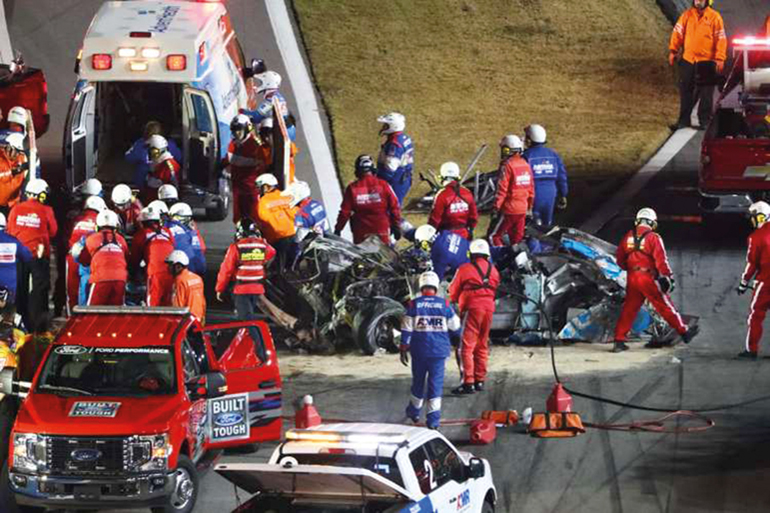
Ever since the late 1990s when hybrid vehicles took to the streets globally, we have watched their slow progression into the field of motorsports, from Formula 1 to World Endurance Championship (WEC) to now having their own open-wheel series, Formula E, and soon to progress into the field of World Rallycross, World Rally Championship and Rally Raid with Extreme E. Marshals and the emergency service personnel have will have to deal with and manage more in the future.
While in many ways these vehicles share all the same hazards of their conventional drivetrain brethren, they have additional hazards that compound and might even confuse emergency service personnel. While some of the information on the various hazards are up to date, others are not and are confusing and are complicated even more by some of the safety entities out there who provide such ‘services’.
This article, across two parts, will look to bridge some of the gaps that exist. So, let us discuss the most important issue here for the responder, their Protective Envelope.

Personal Protective Envelope (PPE)
Most of the PPE worn by the emergency services today is based upon vehicle hazards of the 1960s and ’70s, not today. Yes, the garments worn are made of modern materials, but to what standard are these garments made? The drivers’ suits have manufacturer research behind their garments but not normally as a group.
- SFI Foundation Specs? OK but 3.1 for one-piece or 3.2 for two-piece suits?
- NFPA? NFPA 610 is the standard for Operations at Motorsports Venues which outlines what is acceptable PPE for the various roles of the emergency services.
- ANSI?
- ISO?
- Local sanctioning bodies perhaps?
- FIA? Chapter 2 and Appendix H outline various protective envelopes for the various types of motorsport.
The problem is that they are not current for the hazards with which they are dealing. And the bottom line is that there has been NO research into the personal protective envelope for motorsports emergency service personnel. People will of course point to individual studies for specific items of gear and those studies were performed by the manufacturer of that specific item more than likely. But research has never been performed for the PPE as a total package.
One area that is most lacking is respiratory protection, both for firefighting and for rescue activities. Think of the concerns today with vehicle fires on the street. Today’s vehicles are manufactured from hundreds of pounds of plastics of various forms. Alloys of many types make up the vehicles’ structure and reinforce their integrity. We see forms of carbon-fibre materials and carbon-reinforced plastics as bodywork and structural reinforcements. Alternative-fuelled drivetrains are the rage now so high-voltage batteries can be found as well in these vehicles. Add into the mix a large amount of fuel of some type, except on fully electric vehicles. All this comes together when the vehicle is on fire and produces HUGE amounts of toxic gases, acids, carcinogens, dusts and particles that are a major health issue for responders today.
Now shift this focus back onto the vehicles we see at the track. Regardless of the type of motorsport, it is more than likely that some portion, if not a large majority, of these vehicles are composed of composite materials plus a high-voltage drivetrain battery. Respiratory protection needs to be either positive pressure, that’s BA/SCBA or PPAR, or negative pressure, some sort of filtration mask is the bottom line. Respiratory protection is a huge must today. You need to be prepared for not only the fire concerns but also those associated with hazardous dust particulates and debris from rescues involving composite materials. While strict SCBA probably will not work well for a motorsport environment, a new technology approach of Powered Air Purifying Respirator (PAPR) by an Australian company, Clean Space Technology (www.cleanspacetechnology.com) is an excellent idea for respiratory protection for motorsports responders both in fire suppression and rescue activities.

With regards to composite debris, just like any other debris on the racing surface, always assume that it’s hot and sharp – always! In motorsports today, since the vast majority of vehicles have composite materials to some degree, we can have damaged and or broken composite materials laying on the racing surface resulting from a crash. In a fire situation, we can expect to have some sort of involvement of composite materials as well. But there is a catch with composites. You must watch how you pick them up, as even simple brushing by a piece of composite material can tear apart your PPE and cause injury. All current fabrics used today for protective gear shells and driving suits will be defeated by broken composite materials. A laceration from composites will potentially leave behind microscopic hooks, much akin to Velcro, on your skin that will need to be debrided to be removed, just like skin that has sustained significant burns. What happens with this composite dust, fibres and materials when it gets on your gear and on you? It stays until it is cleaned off. So yes, that means decontamination or at least decontamination wipes. And even this wash-down decontamination needs to be collected as the water run-off will be contaminated. Think of the ramifications from a ‘simple’ incident now, today, resource-wise on the track.
How about that helmet on your head? Opinions are all over the board, from people who say no way, it’s a hazard to block your hearing, to those who feel a full-face helmet should be used. But usually, this full-face helmet is a motorcycle helmet not a race helmet due to cost or even a snowboard helmet a-la F1 pit crews. While these helmets meet standards for their intended use, they are not for use in the field of motorsports rescue. In fact, there isn’t actually a standard for helmets used in motorsport rescue. However, NFPA 610, the standard for operations at motorsports venues, lists some requirements helmets should meet. The closest to a set standard is NFPA 1952 Standard for PPE in a Technical Rescue environment. You should look to see if the helmet meets requirements or standards for impact testing and if it is fire rated. A good helmet that has been tested and rated for side impacts is the Pfanner Protos (www.pfanner-austria.at). This helmet, besides having a face shield, can be equipped with safety glasses even with RX, hearing protection with radio communications and six-point chin strap harness. Remember, any sort of face shield is not eye protection. It is only face protection at best. Safety glasses should always be worn by everyone, especially in this day and age of composites.
Head socks or balaclavas for flash and debris protection should also be a significant consideration, a must for the responders who are charged with fire-suppression and rescue activities. Again, after any type of significant event, whether a fire or a crash, post event that PPE should be part of the decontamination as well as the rest of your gear.
So, what of the gloves you are wearing? There are many different types depending upon the role you play. Most times, emergency service personnel are wearing some sort of rescue/extrication glove that is made of leather, Kevlar and other man-made fabrics with a focus on giving good protection while keeping good manual dexterity. Firefighters should obviously be wearing appropriate fireproof gloves. And, of course, nitrile gloves are a must for medical personnel. A good tip for rescue workers is to put on nitrile gloves first before donning their rescue gloves.

However, one of the items that needs review is the wearing of high-voltage handling gloves on certain classes. In fact, let us take a good look at all the PPE that is issued as proof against injury by high-voltage interaction. While not to poke fun or pick holes in these items, they should be reviewed in light of today’s knowledge and current technology. Ten years ago, these protective items and their methodology were the standard. Not too much was known, so other industries such as the power industry were used as the ‘go to’; however, it was cherry picked not copied. Those over gloves used for handling high-voltage lines are supposed to be tested on a timely basis, usually a six monthly or more often if they are in frequent use. Plus, how well can you perform your role on the track while wearing those over gloves? They are not fire rated, have poor manual dexterity and make it difficult to perform patient care. The same goes for using rubber mats. And let’s not even discuss the logic behind using the shepherd crook; it’s just not on. In addition, not all the tracks wear the ‘required’ gloves and over boot. It appears that certain tracks have proactive safety teams and have adjusted their PPE on their own with their research into better protective items.
Again, space and time does not allow me to go into each and every item in our personal protective equipment. However, we need to establish a dialog on our personal protective envelope across the board. We need to perform unbiased research into PPE and its correct use and methodology.
In part two of this article, we will explore the ramifications of the personal protective envelope for the emergency services.
For more information, email carslayer@roadwayrescue.com
About the Author

David Dalrymple is a volunteer FF/EMT/Rescue Technician for Clinton EMS/Rescue in Clinton, N.J. He has been actively involved with emergency services for 37 years and is the executive educator for RoadwayRescue LLC (www.roadwayrescue.com). He is also the education chair for the Transportation Emergency Rescue Committee – US (TERC–US). Certified as a fire service instructor by the State of New Jersey, he has been actively teaching transportation rescue topics for over 27 years.
