
Is your fire department or emergency management agency prepared to deal with a hurricane, typhoon or cyclone? I mention three terms but they can be used interchangeably, depending on the particular area that the storm occurs on Earth. For this article, I will use the term hurricane since that’s the term I am familiar with and use most often.
The topics discussed are issues that needed to be dealt with concerning my fire department and the challenges that we face when a strong hurricane impacts our jurisdiction. Like a tsunami or earthquake, a hurricane has the potential to affect a large number of the population at once, quickly becoming an emergency that is beyond what the local fire department can service alone. There is a level of risk that a community must be willing to accept. It is too costly to be prepared for every type of emergency imaginable and preparing to protect every citizen during a hurricane is unreasonable. However, the fire department must be able to survive a hurricane. This includes personnel and equipment. Although the devastation from a hurricane can be tremendous and deadly, there are things that a fire department can do to minimize the chance of becoming a hurricane casualty.
The fire department must also understand the roles that other emergency response agencies are responsible for. Other agencies may be government or non-governmental organizations (NGO’s). Having a written plan in place between these organizations will alleviate confusion and the overlapping of tasks that need to be completed. Knowing what is expected of your fire department, and sharing those goals, is a great first step. For example, in some jurisdictions, the task of evacuating people from the hurricane threatened area is left to the police department. In other areas it may be the fire department. In any case, know who is responsible for these various tasks.
I will point out the importance of:
A Emergency radio communications
B Involving citizens
C Response limitations
D Self Preservation of responders
Emergency Radio Communications
A large emergency that covers a sizable geographic area can make radio communication requirements a nightmare for any fire department. Having too few radio frequencies or radio channels for emergency personnel can create an atmosphere of chaos. Knowing that more help is needed but not being able to communicate for help is demoralizing for a fire fighter at a scene. Waiting for a busy radio communication channel to free up can be frustrating.
My Department has 10 fire stations on one dispatch radio channel. Out of those 10 stations, there are over 20 emergency vehicles that could conceivably be activated at the same time after a tremendous storm. Although there are other available radio frequencies that we can utilize, assigning those frequencies immediately after a storm is too late. Radio channels need to be included in written policies well before the storm. Imagine the chaos that would result from 20 different crews tying to communicate with superiors on one or two channels. What channel should they use? Who else is on the channel? These are the types of questions that need to be answered prior to the event.
A very strong hurricane will likely affect radio transmission towers and equipment. In cases like these, a satellite phone or amateur (HAM) radio may be your only option. A secondary form of communication needs to be discussed and implemented in policies. In a worst case scenario, you may need to use “runners” to transmit information. Vehicles may not be an option due
to blocked or impassible roadways. Every fire department needs to have a comprehensive communication plan in place for catastrophic events.

Involving Community Members
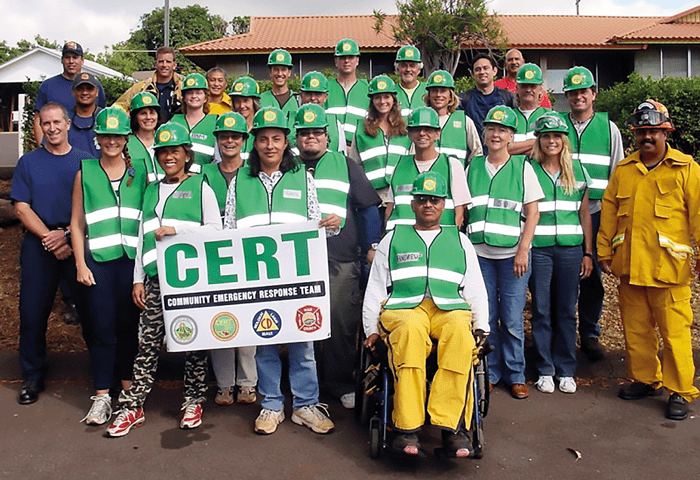
Being able to utilize minimally trained community members for light assignments will allow fire fighters to concentrate on the more moderate and severe tasks after a hurricane. Trained community members can be assigned to assist with evacuation or easy searching of victims. They can also assist by attending to minimally injured citizens or contribute by simply assisting with documentation. The Community Emergency Response Team (CERT) is a program in the United States that promotes the training of civilians to assist emergency responders during a large emergency or disaster. CERT members are not fire fighters but they provide the ability to perform light tasks that may turn in to a moderate or severe problem if left unchecked. The key is for the fire department to provide the training prior to the disaster.
In areas where there are no trained community members to assist the fire department, it is still useful to utilize citizens who are capable of helping. Some may wonder if citizens may be too traumatized by a devastating hurricane to offer valuable assistance. Research and past events have proven otherwise. Dr. Henry Fischer’s book “Response to Disaster” provides valuable information on the sociological impact on disaster victims and he shares research findings that show how capable survivors are after a disaster (Fischer III, 2008).
During the 2004 Indian Ocean tsunami, thousands of people lost their homes and loved ones. These survivors began to participate in search and rescue efforts immediately. Knowing this, emergency personnel must understand how to guide and accept this behavior. Having a plan to organize civilian help will reduce the chaos that may arise from uncoordinated efforts. The Fire Department, or the responsible mitigation agency, must be willing to funnel these efforts and direct the citizens during the mitigation. There are a number of benefits to this approach. First, if the fire department does not accept the assistance of the residents, the residents will participate in mitigation efforts regardless. Second, those assisting will lessen the burden of emergency sheltering space for those who may need it more. Third, allowing capable victims to perform work will help them in the healing process by maintaining their dignity and staying busy. Fourth, the responsible agency will create a better relationship with the community and gain valuable information regarding the overall aftermath of the storm.
Response Limitations
Fire Department personnel shall not respond to emergencies during a hurricane when it becomes dangerous to do so. Sustained winds in excess of 40 miles per hour shall be the signal for emergency personnel to take shelter and cease emergency operations. This does not mean that personnel shall take shelter when winds reach speeds of 40 miles per hour. A sustained wind is one which is consistent for at least one minute. Gusts of wind may reach speeds of 50 or 60 miles per hour but they may not be sustained. Only an anemometer or windmeter is capable of providing accurate wind speeds. In the absence of these tools, updated information might be obtained from your local weather service to determine when to take self-preservation measures.
High winds can cause debris to be flown and injure fire personnel. Roofing materials and branches from trees are already elevated and can be torn away, landing on persons and equipment. Emergency vehicles that have a large side, or high profile, may act as a wind sail and flip over. Although I have not found studies that have shown how much wind is needed to tip an emergency vehicle over, some engineers have calculated this to be possible in extremely high winds.

Self-Preservation
Is your fire department located close to the shoreline? Can your fire station be threatened by a hurricane storm surge or intense winds? If so, do you have a secondary location to safely shelter during the hurricane? Will it be safe to shelter in the fire station? Facilities that house fire department personnel must be able to withstand high winds and rain. A recent study for my fire department has recommended that fire department facilities be constructed to withstand hurricane force winds of a category 4 hurricane (Maui, 2013). A Saffir-Simpson scale category 4 hurricane has sustained wind speeds between 130 and 156 miles per hour. When designing facilities, fire departments need to work with structural engineers and hurricane experts to determine the level of stability facilities need to be constructed to. Citizens need to understand that if the fire department does not survive a hurricane event, who is going to help immediately after the storm has passed? It is a costly decision to erect such a stable structure but a very important one the community depends on.
Once the hurricane has passed, are your fire department personnel capable of self-preservation within the fire station facility for 3-7 days? There must be enough food, water and fuel to last until assistance can arrive. Every jurisdiction is different and the length of self-preservation requirements vary. How long will it take to replenish food, water and fuel to your area after a damaging hurricane? Remote areas serviced by boat or airplanes will obviously need to stock more quantities.
Secondary electrical power is critically important. A fuel driven generator will be able to maintain refrigerators, power batteries for communication and operate computers when electrical utility service is disrupted for fire department personnel. Emergency responders need water for drinking and sanitation. Potable water systems depend on electrical pumps to maintain adequate service levels. A dependable generator is invaluable to rescuers when primary sources of electricity are unavailable. A calculation of the electrical demands must be considered to adequately size the secondary generator.

Conclusion
There are catastrophic events that can make the fire departments response difficult or unavailable. The above topics are just a few things to consider and have hopefully been thought provoking to assist your agency or department to prepare for a hurricane. Many of these topics can be interchangeable with other disasters such as an earthquake, tornado or landslide. It is important to exercise and practice any emergency plan created to identify shortcomings and pitfalls in the plan. It takes time and practice to create an effective continuity plan. It is also imperative that the plan be shared with those who need to know well before a disaster occurs.
For further information, go to www.usfa.fema.gov/training/nfa/
[su_note]References
- Agency, F. E. (n.d.). Community Emergency Response Teams. Retrieved from https://www.fema.gov/community-emergency-response-teams
- Fischer III, H. (2008). Response to Disaster. Lanham: University Press of America, Inc.
- Hampton, R., & Tim, M. (2006). WILL POWER, The Story Beneath Katrina in New Orleans. New Orleans.
- Maui, C. o. (2013). Maui County, Hurricane Response Logistics Concept of Operations.[/su_note]
About the Author

Valeriano Martin is Assistant Chief with the Maui Fire Department in Hawaii. He has 24 years of fire service experience.
