
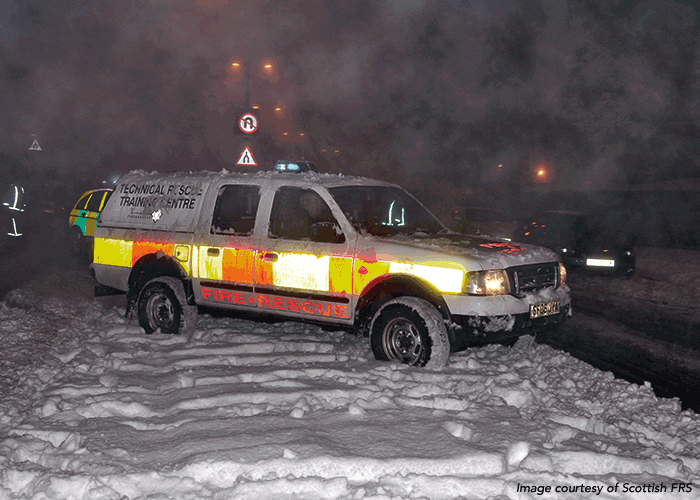
We all know what a danger fire can be. But have you also considered what a danger ice can be? If your station is in an exposed area or on a steep incline, chances are you’ll have to be on full alert the minute you step outside during the winter months.
Winter in the UK is firmly here and brings with it the usual challenges – increased danger of slips and trips and restricted vehicle movements being just two dangers regularly faced by organisations throughout the UK. Fortunately the UK Highways Agency will grit major roads in a carefully planned priority system, though organising gritting on site falls under the remit of the organisation and can be an onerous additional task to coordinate.
It is often the case that roadways are clear enough to get to a place of work but the site itself can be icy, slippery or even under snow – leading to many logistical issues and often loss of business.
Fire stations and other emergency services are not immune from this problem and it is vital that these issues are addressed to ensure trouble-free ingress and egress at any point during the day, whatever the weather.
Clearly the emergency services have many tasks to perform – but predicting the weather ahead of a potentially cold snap and minimising the associated dangers come towards to bottom of a very large ‘to-do’ list – so it makes sense to consider utilising the services of a private gritting and snow clearing contractor who will monitor the weather and treat key areas before ice or snow form, mitigating risk and helping ensure uninterrupted service.

Awareness
In the UK, the Met Office works together with Public Health England to raise awareness and motivate people to take precautions during long periods of cold weather by providing cold weather alerts. These alerts are sent to all National Health Service Trusts throughout England as well as the general public through the Met Office website, public weather forecasts on radio and TV and also through social media. The alerts become active in November and end in March.
The Cold Weather Alert system has two clear trigger points:
- When mean temperature remains below two degrees Celsius for 48 hours or longer.
- When a region experiences heavy snow and/or widespread ice.
The trigger points have been developed in consultation with the Department of Health and the Health Protection Agency and only one of them needs to be breached in order for one of the following cold weather alerts to be issued:
- Level 1 (Green) – Winter preparedness and long-term planning: This is the lowest state of alert during the winter months. At this level social and healthcare services will ensure that people are aware of and prepared for potential cold weather.
- Level 2 (Yellow) – Alert and preparedness: Once the risk for any of the thresholds is above 60%, the Met Office will trigger a yellow alert. At this point social and healthcare services will ensure they are ready and prepared to act in order to reduce harm from prolonged periods of cold weather.
- Level 3 (Amber) – Cold weather action: Amber alerts are issued as soon as any of the thresholds have been breached. Once in place, social and healthcare services will put in place specific actions to support those perceived to be at high-risk.
- Level 4 (Red) – Emergency: This is the highest level of alert and is reached when cold weather is so severe and/or prolonged that its impact reaches beyond the health and social care system. It is issued on the advice of, or in collaboration with, the government and when health risks extend to the wider population.

Action
Reputable private gritting contractors work closely with the MET office and other private forecasting companies along these lines, operating a similar traffic light system of risk analysis to decide when gritting and/or snow clearing is to be undertaken.
- Level 1 (Green): Road Side Temperatures (RST) are forecast to be +2 °C or higher. It is unlikely that ice will form.
- Level 2 (Yellow): RSTs are forecast to be between +0.6 °C and +1.9 °C – there is a lower risk of frost, ice or snow but taken together with moisture and precipitation levels, this may trigger an alert and pre-emptive gritting.
- Level 3 (Amber): RSTs are forecast to be +0.5 °C or below (including dry roads below 0.0 °C) – there is still a risk of frost, ice or snow and depending on location and moisture levels, gritting often takes place.
- Level 4 (Red): Frost, ice and/or snow are forecast to occur. Immediate action is required.
It seems a simple formula, however, locations and microclimates must also be factored in. Microclimates are local atmospheric zones where the climate differs from the surrounding area. These zones can range in size from a few square feet to several square miles and are influenced by a number of contributing factors including:
Altitude
The higher you are above sea level, the colder the temperature will be.
This occurs because the air is thinner at higher altitudes, thus it absorbs and retains less heat. The temperature usually decreases by 1 degree Celsius for every 100 metres in altitude that you climb.
Distance from the Sea
As a result of oceans heating up and cooling much more slowly than land, coastal locations tend to be much cooler in the summer and warmer in the winter compared to inland locations at a similar latitude and altitude. For example, Glasgow is at similar latitude to Moscow, but experiences much milder winters as a result of being closer to the coast.

Prevailing Winds
The direction of prevailing winds can impact upon temperatures and weather conditions:
- Winds blowing off the sea will often bring rain to the coast and dry weather to inland areas.
- Winds blowing from warm inland areas, such as Africa, tend to be warm and dry.
- Winds blowing from cooler inland areas, such as central Europe, will often be cooler and dry.
- The UK most frequently experiences south westerly winds from the Atlantic, bringing cool winds in the summer and mild winds in the winter.
Urban Climates
Urban climates refer to atmospheric conditions (temperature, humidity, wind speed/direction and air quality) in an urban area that differ from those in the surrounding rural environment.
On average urban temperatures are between one and three degrees Celsius higher, but
can be as much as 10 degrees Celsius higher than rural environments under calm and
cloud-less conditions.
Hills and Mountains
- Anabatic/Upslope Winds: During the day, sun facing hills, mountain slopes and the air above them get heated faster than the adjacent atmosphere. As a result the density of the air decreases, causing it to rise. This causes more air to rise from below to replace it, producing wind.
- Katabatic/Gravity/Downslope Winds: In the evenings, as the highland loses heat, the air coming into contact with it also begins to cool. This causes it to become denser than the air around it and it therefore begins to flow downhill, generating a wind.
Gritting
One or more of these factors can have a direct impact upon local climates and therefore have an effect on the decision as to whether proactive gritting and/or snow clearing should take place.
Where weather forecasts and detailed climate analysis concur, gritting and/or snow clearing should be undertaken ideally at the optimum time from both a weather and site operations viewpoint. For example, gritting is most effective before ice forms but cannot be undertaken before all risk of rain has gone. If it is undertaken too early rain will wash away the salt used. The gritting contractor should be able to advise and treat the agreed areas within a narrow timeframe.
Site specific gritting and snow clearing plans should be agreed and in place well before the risk of bad weather – the plans should show the areas to be gritted, the type of equipment, the route, hazards and areas that snow is to be stacked in the event of snow clearing after a heavy snow fall. This should be reviewed regularly during the course of the contract and also include matters such as entry and exit points to the site, security/check-in arrangements and the issuing/withdrawing of access cards. As well as the site plans, site-specific risk assessments and method statements should be in place for every site – most of this is a prerequisite for the £10 million Public Liability insurance that reputable private gritting contractors should have in place.

Unpredictable Winters Ahead
In recent years weather unpredictability in the UK has been very evident:
The winter of 2009/10 saw the UK experience its coldest winter for 30 years.
Weaker westerly winds also brought cold weather during the winter of 2010/11.
However 2013/14 was much more mild and stormy, resulting in the devastating floods that caused considerable disruption to many areas of the Country.
This unpredictability highlights the importance of being prepared for whatever the winters ahead may throw at us. Choose your winter risk management partner with care and discuss with them how best to be protected from the threat of ice and snow – so you can concentrate fully on the service you provide.
The right partner will help you by ironing out all the variables and unpredictability and allow you to make decisions in black and white.
Or fire and ice, if you prefer.
For more information, go to www.icewatch.co.uk
